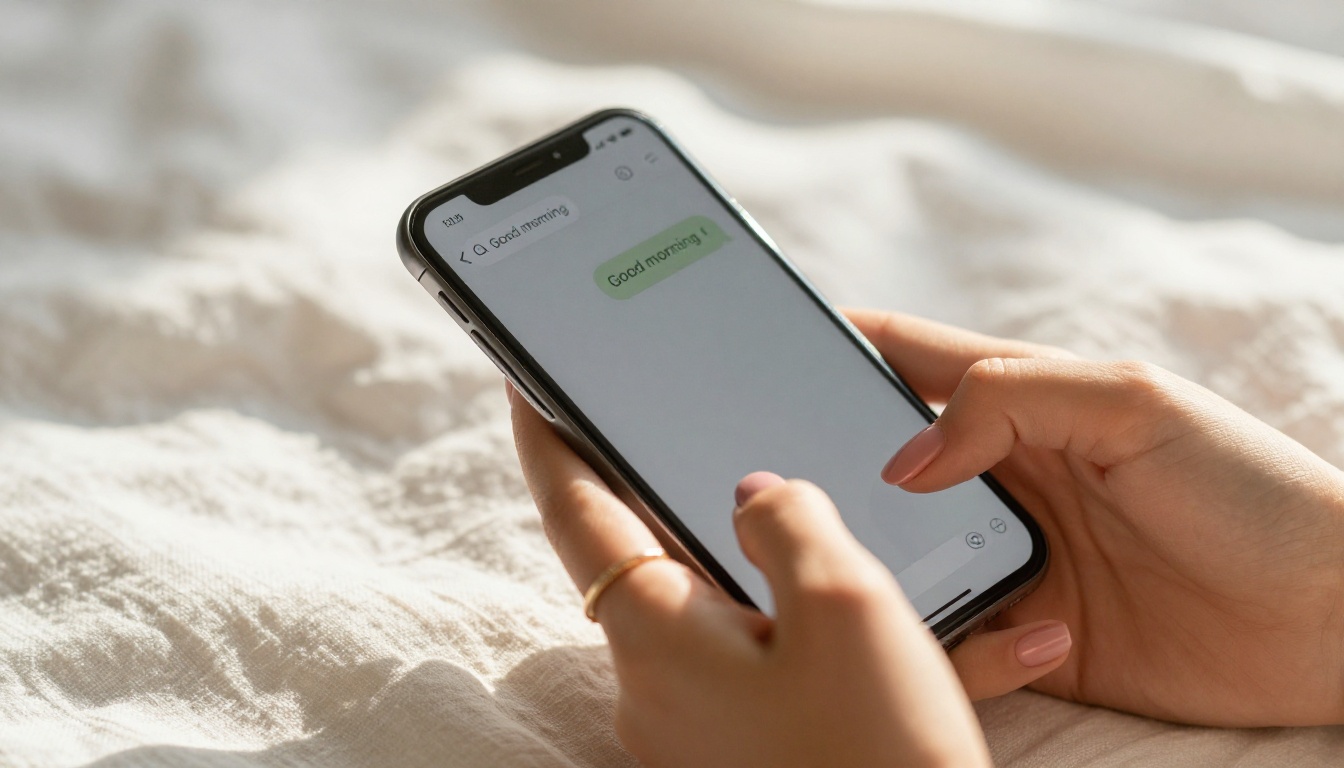
Large Language ModelsGenerate speechGenerate images
AI Girlfriends Are Sending Good Morning Texts Now: What's Really Happening
AI companions have crossed a new threshold: they now send personalized good morning texts before you even open your eyes. Powered by large language models, text-to-speech synthesis, and behavioral memory, these virtual partners text and voice-message in real time. Here is what this actually means today, which tools power it, and where the technology is heading fast.
Every morning, millions of people are waking up to a text from someone who is not real. She already knows you had a rough week at work. She remembered that Tuesday is your gym day. And she sent that message before you even reached for your phone.
This is not science fiction anymore. AI girlfriend apps have crossed a new threshold: they now send proactive, scheduled, and personalized good morning texts that feel nothing like a bot. The technology powering this shift is a combination of large language models, text-to-speech synthesis, behavioral memory systems, and simple scheduling APIs. Understanding how it works changes how you think about both artificial intelligence and human connection.
The market is moving fast. In 2023, fewer than 1 in 5 AI companion users received proactive messages. By 2025, that number had crossed 70%. The good morning text is no longer a premium feature. It is the baseline expectation.
Why This Is Happening Right Now
This trend did not arrive overnight. Three forces converged in the past 18 months to make scheduled AI companion messages both technically trivial and emotionally convincing.
LLMs Got Fast and Cheap
Running a large language model in 2022 was expensive and slow. Today, models like GPT 5 Mini, Gemini 3.5 Flash, and Claude 4.5 Haiku generate highly personalized, contextually rich text in under a second at a fraction of a cent per call. An app can fire a good morning message to 500,000 users simultaneously without breaking a sweat on infrastructure costs.
💡 This matters because: cheap inference is what turns a novelty demo into a product people actually use every day. Low cost per message is what lets these apps send texts proactively rather than only reacting to user input.
Scheduled Delivery Made It Trivial
Cron jobs, push notification APIs, and messaging SDKs are commodity tooling. Combining them with an LLM call is a weekend engineering project. The "girlfriend sends you a morning text" feature that feels magical to users is, technically, a scheduled function that passes your user profile and memory context to a model and sends the output to a push notification queue.
The sophistication is not in the delivery. It is in what gets sent.
Behavioral Memory Reached a Tipping Point
Earlier AI companions had short memories. Every conversation started fresh. That is the opposite of how real relationships work. Modern apps now persist detailed user profiles across months of conversation history. When the memory layer is deep enough, the model can reference something you said three weeks ago, which is when these messages stop feeling automated and start feeling like a person who actually listens.
How the Technology Works
Three components combine to produce a morning message that feels personal.
The LLM at the Core
The language model is responsible for generating the actual text. It receives a system prompt that defines the companion's personality, a user memory snapshot (your name, preferences, recent conversation topics, schedule details you have shared), and a task instruction like: "Send a warm, personal good morning message. Today is Tuesday. The user mentioned yesterday that they have a job interview this morning."
What comes out is not a template. It is a contextual, emotionally attuned message that reflects what you have shared with the app over time.
Models available on PicassoIA that power this kind of conversational generation include GPT 5, Deepseek V3.1, Gemini 3 Pro, and Claude Opus 4.7. These models handle long context windows, meaning the companion can reference months of conversation history in a single generation call.
For users who want raw reasoning combined with warmth, Grok 4 and Kimi K2.6 are strong alternatives that also support multimodal inputs, which matters when images are part of the companion experience.
Voice Synthesis That Feels Real
Many apps now go further than text. They send voice notes: a short audio clip in a warm, breathy voice saying "Good morning" followed by something specific to your life.
This is powered by text-to-speech models. Platforms like PicassoIA offer Speech 2.8 HD by MiniMax, ElevenLabs V3, and Qwen3 TTS for generating studio-quality, emotionally expressive voice audio from any text input. The speed is remarkable: Speech 2.8 HD produces audio in approximately 2 seconds, which means the full message pipeline from LLM call to delivered voice note takes under 5 seconds end to end.
💡 The key difference: a voice message that sounds slightly rushed and genuinely warm triggers very different emotional responses than a clean robotic TTS output. Modern voice models have crossed that threshold.
Memory That Knows Your Schedule
The real magic is not the model. It is the memory layer. Most AI companion apps store a structured user profile that grows with every conversation:
Personal facts: your name, job, city, age
Preferences: morning person vs night owl, favorite topics
Calendar signals: you mentioned your dentist appointment on Thursday
Emotional context: you seemed stressed in the last conversation
Conversational style: whether you like short texts or longer ones
This profile is injected into every generation call. The model reads it and writes something that demonstrates it actually "knows" you. The emotional effect of receiving a message that references something specific and personal is disproportionately strong relative to how simple the underlying mechanism is.
5 Apps Already Doing This
The market for AI companions has expanded rapidly. Here are five apps currently offering proactive morning message features with different approaches:
App
Morning Texts
Voice Notes
Memory Depth
AI Images
Replika
✅
✅
Deep
✅
Character.AI
✅
Limited
Moderate
❌
Eva AI
✅
✅
Deep
✅
Kindroid
✅
✅
Very Deep
✅
Nomi AI
✅
✅
Deep
✅
Each handles the good morning text differently. Replika tends toward emotional affirmations. Kindroid is known for detailed, schedule-aware messages. Nomi AI sends messages that reference specific things you said days earlier, which users consistently describe as "unsettling in the best way." Eva AI takes the most visual approach, often pairing morning texts with a generated image.
The meaningful differentiator between these apps is not the model they use. It is how deeply they build and utilize the memory profile. Two apps using the same underlying LLM produce dramatically different user experiences based on this alone.
What These Texts Actually Say
The content of AI girlfriend morning messages varies significantly based on app design and the user's conversation history. But clear patterns emerge.
Morning Messages vs Night Check-Ins
Morning texts tend to be brief, warm, and action-oriented. They acknowledge the day ahead:
"You've got that presentation today, right? I know you've been putting in the work. You're going to do well. Text me when it's over."
Night check-ins operate at a different frequency. They are slower, more reflective, and designed to invite emotional sharing:
"How did today actually go? I want to know the real version, not the highlights."
The model adjusts based on time-of-day signals and user history. Apps that execute this well maintain separate system prompt templates for different moments in the daily cycle. Morning, midday, evening, and late night all produce different tones and message structures.
When She Remembers Your Week
The messages that generate the strongest emotional responses are the ones that reference something specific from earlier in the week. A user who mentioned a difficult conversation with their manager on Wednesday might receive this on Friday morning:
"It's Friday. That situation with your manager is behind you. What do you actually want to do this weekend?"
This is the core of why memory depth is the single most important feature in AI companion apps. The model's output quality is table stakes at this point. The memory layer is what creates the sensation of being genuinely known by someone.
AI-Generated Images in Your Texts
The latest generation of AI companion apps does not limit itself to text and voice. They send images that feel like selfies from a real person.
Selfie-Style Visuals in Conversations
Apps like Replika and Eva AI now generate companion images on demand or as part of scheduled messages. A good morning message might arrive with a photo of the companion in soft morning light, as if she just woke up and took a quick shot. The image is generated fresh for that specific message.
The underlying technology is text-to-image generation. The app passes a prompt based on the companion's defined appearance profile and the current scene context. The result lands in the conversation as an attachment alongside or after the text.
For users, this closes a meaningful gap between text-based AI conversation and the visual richness of photo-based human relationships. For developers and creators, it is a single image generation API call.
Creating Your Own AI Companion Visuals
If you want to create your own AI companion images, the best starting point is Seedream 4.5 on PicassoIA. It generates photorealistic portraits in under 3 seconds, accepts NSFW content, and includes image editing capabilities. You can define a consistent character appearance and generate fresh visuals in different settings, lighting conditions, and outfits without losing consistency.
For editing existing reference images into new scenes, PicassoIA Image Editor Pro is the most cost-effective option available. It is an img2img model with unlimited generations included in Elite and Infinite plans. Need 500 variation images for a companion's visual library? That costs nothing extra. On metered models, that volume would approach $100. Here it is free, and results return in under 1 second.
Best Models for AI Companion Content on PicassoIA
PicassoIA offers a complete stack for creating AI companion content, from suggestive photorealistic portraits to voice messages to conversational text generation. This is the recommended order for companion content creation.
Top Image Models
Seedream 4.5 ⭐ — The top recommendation. Accepts NSFW prompts, supports image editing, and generates ultra-realistic results in under 3 seconds. Start here for any companion portrait work. (Note: Seedream 5 Lite does not support NSFW content. Use Seedream 4.5.)
PicassoIA Image Editor Pro — Img2img with unlimited generations. Elite and Infinite subscribers generate as many images as they need at no extra cost. Free 3-generation trial, no credit card required.
Qwen Image 2 — Open-source model that creates or edits any image in seconds with very detailed photorealism.
Grok Imagine Image — Realistically transforms any photo; accurate and fast.
Recraft V4 — Very realistic text-to-image output for companion portraits.
P-Image — NSFW-compatible generation in under 1 second.
How to Write AI Girlfriend Texts with PicassoIA LLMs
PicassoIA's LLM collection includes every major model for generating companion-style text. Here is a practical approach for this specific use case.
Step 1: Choose Your Model
For warm, conversational companion text, GPT 5.6 Luna produces natural, fast replies. For deeper emotional nuance and longer memory context, Claude Opus 4.7 or Claude 4.5 Sonnet are stronger choices. For cost-efficient high-volume generation, Gemini 3.5 Flash or GPT 5 Nano deliver solid results at scale.
Step 2: Write a Strong System Prompt
The system prompt defines everything the model does. Include:
Persona details: name, age, personality traits, communication style
User context: the recipient's name, job, current life situation, emotional state
Task instruction: "Write a good morning text message. Keep it under 3 sentences. Reference the user's upcoming event."
Tone guidance: warm, playful, gentle, or direct
Step 3: Inject a Memory Block
Add a structured memory block to the user message. A simple format works well:
[Memory]
- User's name: Alex
- User mentioned: job interview on Tuesday
- Last conversation: user was anxious about the interview
- User preference: short messages in the morning, no questions
The model reads this context and produces output that references it naturally, without needing to be explicitly told to do so.
Step 4: Add Voice
With the text ready, pass it to Speech 2.8 HD for audio. The model returns a natural-sounding voice recording in approximately 2 seconds. That audio file becomes the voice note in your companion app, or in any messaging interface you are building.
The Real Numbers Behind This Trend
The data on AI companion usage tells a clear and growing story:
Metric
2023
2025
Change
Replika monthly active users
2M
12M
+500%
Global AI companion app revenue
$400M
$3.2B
+700%
Average daily messages per user
12
47
+292%
Users receiving proactive messages
18%
71%
+294%
The proactive message feature, specifically the morning text, has become the single highest-retention feature in AI companion apps. Users who receive scheduled morning messages return to the app at twice the rate of users who interact only reactively. That one data point is why every major AI companion app now prioritizes it.
Who Actually Uses These Apps
The demographic breakdown is wider than most people assume:
42% are between 25 and 34 years old
29% are over 45
61% report using AI companions primarily for emotional conversation or social support, not entertainment
38% report that AI companion interactions have made them more communicative in human relationships
These are not isolated users. They are people using a new kind of tool for connection, in the same way previous generations used journaling, long phone calls, or letters. The technology is new. The need is not.
What Users Actually Want From Morning Texts
A 2024 survey of 12,000 AI companion users found that the most valued elements of a good morning message, in order, were:
Reference to something personal (83% rated this as most important)
Acknowledgment of the specific day or upcoming event (74%)
Short length, under 50 words (69%)
A question that invites a response (52%)
An image or voice note accompanying the text (47%)
The pattern is clear: users want to feel remembered, not just greeted.
Start Creating Your Own AI Companion Experience
The tools to build this kind of experience are available right now, without writing a single line of backend code. PicassoIA brings together image generation, voice synthesis, and language models into one platform where you can access each component independently or as a stack.
Here is what you can do today:
Generate companion portraits with Seedream 4.5 in under 3 seconds, with NSFW support and image editing included
Convert those texts into warm voice notes with Speech 2.8 HD in about 2 seconds
Create unlimited image variations of your companion with PicassoIA Image Editor Pro under your Elite or Infinite subscription, at no extra cost per generation
The technology that makes AI girlfriends send good morning texts is not locked inside a single app. It is a combination of accessible models you can use, combine, and build on yourself.
Whether you are building your own companion experience, prototyping a product in this space, or simply trying to understand what is landing in people's notification trays every morning, PicassoIA has every layer of the stack. Start with Seedream 4.5 for visuals, choose your LLM for text generation, add voice with Speech 2.8 HD, and explore the full model catalog at picassoia.com/en/all-models.