GPT 5.5 arrived quietly but changed how serious data work gets done. Not because it automates everything, not because it replaces analysts, but because it finally closes the gap between asking a question and getting a genuinely useful answer from messy, real-world data. If you have spent time wrestling with spreadsheets, query builders, or BI dashboards, this version of GPT does something different from its predecessors in ways that actually matter on the job.

What GPT 5.5 Actually Does
Beyond autocomplete: real reasoning
Earlier GPT versions were impressive at text generation but had a fundamental problem with numbers: they were statistically predicting the next token, not reasoning through numerical relationships. GPT 5.5 addresses this at the architecture level. It carries a significantly expanded context window and a revised chain-of-thought approach that keeps intermediate steps in working memory rather than discarding them as each token generates.
What this means practically: when you paste a CSV of 50,000 rows and ask "what is driving the spike in refund rates this quarter?", GPT 5.5 can hold the shape of the entire dataset in context, trace the spike to a specific product category, cross-reference it with shipping delay data in the same file, and give you a structured hypothesis in a single response. That was not reliably possible before.
💡 Important distinction: GPT 5.5 reasons over data you provide. It does not connect to live databases on its own. You still need to extract and format the data, but what happens after that changes significantly.
How it reads structured data
One of the most practical improvements is how GPT 5.5 handles tabular data. Previous models would frequently hallucinate column names, confuse similar headers, or lose track of row counts over long CSVs. GPT 5.5 treats tables more like a structured object than a text block. It can:
- Identify and flag mismatched data types within columns
- Detect outliers based on statistical distribution without being explicitly prompted
- Infer relationships between columns even when not labeled clearly
- Summarize data at multiple levels of granularity in a single pass
This matters because most real-world data is dirty. Headers are inconsistent. Some cells are blank. Dates are formatted three different ways in the same column. Where an analyst might spend 40 minutes on initial inspection, GPT 5.5 can surface the same issues in under 30 seconds and propose cleaning strategies.

Talking to Your Data in Plain English
Natural language queries that work
The phrase "talk to your data" has been overused to the point of meaninglessness. Most tools that claimed to support it required careful prompt engineering, specific syntax, or still needed you to know SQL underneath. GPT 5.5 is the first version where natural language queries consistently return accurate results without that overhead.
You can ask things like:
- "Which sales regions outperformed their Q1 targets by more than 15%?"
- "Show me the top 10 customers by revenue, excluding one-time purchases."
- "What is the average order value for mobile vs desktop users in the last 6 months?"
And get back correct answers with the methodology shown, not just the number. This transparency is one of the most important practical improvements. You can see exactly how the model interpreted your question and correct any misinterpretations before acting on the output.
When context matters more than code
Code-based tools like Python, R, and SQL are precise and reliable, but they require you to specify every transformation explicitly. GPT 5.5 introduces something different: contextual inference. It uses the broader framing of your question to make sensible assumptions about what you actually want.
For example, if your dataset contains a column called signed_date and you ask "how many contracts were signed last year?", GPT 5.5 figures out that "last year" means 2025 based on the current date, that signed_date is the relevant column, and that "contracts" maps to rows in your data. It does this without being told. A SQL query requires all of that spelled out explicitly.
💡 Practical tip: For best results, include a brief description of what the data represents at the top of your prompt. GPT 5.5 uses that framing to make better assumptions throughout the session.

Real Applications in 3 Industries
Finance: spotting patterns fast
In financial work, speed of interpretation matters. A portfolio manager reviewing 12 months of position data does not just need numbers, they need the pattern. GPT 5.5 can ingest quarterly P&L statements, identify which expense categories grew faster than revenue, flag anomalies in margin compression, and produce a plain-English summary of what happened and why, in under a minute.
One particularly useful application is in variance reporting. Instead of building manual waterfall charts, analysts can paste budget vs. actual data and ask GPT 5.5 to explain the top 5 contributors to the gap. The model correctly prioritizes absolute impact over percentage impact without being told to, which is the same judgment call a skilled analyst would make.
Common finance use cases:
| Use Case | What GPT 5.5 Does |
|---|
| Variance reporting | Identifies and ranks root causes of budget gaps |
| Trend detection | Flags statistically significant shifts in time series data |
| Report drafting | Converts raw numbers into structured executive summaries |
| Anomaly detection | Surfaces outliers and asks clarifying questions |
| Forecast review | Compares actuals to prior forecasts and scores accuracy |
Marketing: making sense of attribution
Attribution modeling is one of the messiest problems in marketing data. GPT 5.5 does not replace your attribution model, but it dramatically speeds up the interpretation layer. You can drop in a multi-channel attribution report and ask which channels are being over-credited relative to their position in the funnel, and get a reasoned response that accounts for recency bias, touchpoint frequency, and conversion lag, without writing a single formula.
It is also useful for cohort interpretation. Marketing teams frequently produce retention tables but struggle to articulate what they mean. GPT 5.5 can read a retention matrix and explain the story: which cohorts are performing better, where the biggest drop-off points are, and what that implies for onboarding or lifecycle messaging.
Healthcare: structuring messy records
In healthcare data, the challenge is rarely computation. It is structure. Patient records contain free-text notes, inconsistent coding, and mixed formats across departments. GPT 5.5 can take unstructured clinical notes and extract structured fields: diagnosis categories, medication references, procedure dates, and follow-up requirements, at scale.
💡 Note on sensitive data: Always anonymize patient data before using any AI model. GPT 5.5 is a reasoning tool, not a HIPAA-compliant data processor on its own. Use it in approved, controlled environments only.
This application is particularly valuable in retrospective chart reviews, where clinicians or data teams need to extract structured information from thousands of historical notes that were never coded consistently.

GPT 5.5 vs Earlier Versions
Speed and context window
GPT 5.5 processes significantly more context per session than GPT 4.x models and handles it faster. The practical effect: you can paste an entire quarterly report, a competitor benchmark, and a regional dataset into the same session and ask questions that draw across all three. Earlier models would either truncate the data or lose coherence when context grew too large.
Response latency on complex multi-step questions has also improved. Tasks that previously required multiple follow-up prompts to complete can now resolve in a single well-structured response.
Accuracy on numerical data
This is where GPT 5.5 shows the most improvement over GPT 5.1 and GPT 5.2. Numerical precision on derived calculations, such as compound growth rates, weighted averages, and conditional aggregations, is substantially more reliable. The model still makes errors on very long arithmetic chains or highly nested conditions, but the frequency of silent arithmetic mistakes has dropped considerably.
A quick comparison
| Capability | GPT 5.1 | GPT 5.4 | GPT 5.5 |
|---|
| Context window | 128K | 256K | 512K+ |
| Tabular data handling | Good | Very good | Excellent |
| Multi-file cross-referencing | Limited | Moderate | Strong |
| Numerical precision | Moderate | Good | Very good |
| Natural language query accuracy | Good | Very good | Excellent |
| Speed on large inputs | Moderate | Fast | Very fast |
Limitations Worth Knowing
Where hallucination still shows up
GPT 5.5 is better, but it is not immune to confident errors. Hallucinations in data contexts tend to show up in specific, predictable ways:
- Invented aggregations: The model may state a total or average that is slightly off, particularly when working from partial context
- False column assumptions: If two columns have similar names, the model may conflate them without flagging the ambiguity
- Date range errors: Calculations involving fiscal years, rolling periods, or custom date ranges are prone to off-by-one errors
- Extrapolation beyond data: If asked about trends, the model sometimes extends patterns further than the data supports
The fix for most of these is straightforward: always ask the model to show its work and verify the methodology before acting on the output.
💡 Rule of thumb: Treat GPT 5.5 outputs like a first draft from a sharp junior analyst. Review the reasoning, not just the number.
What it won't replace
GPT 5.5 is not a data warehouse. It cannot query your live production database directly. It does not replace proper BI infrastructure, data governance frameworks, or statistical modeling software for rigorous hypothesis testing. It also cannot replace the domain expertise required to know whether a finding is actionable.
Where it genuinely shines is in the interpretation and communication layer: taking data that already exists and making it faster to read, summarize, and act on. That is a valuable niche, and it is one that GPT 5.5 fills better than anything before it.

Pairing GPT 5.5 with Visual AI
From data to visuals in one pipeline
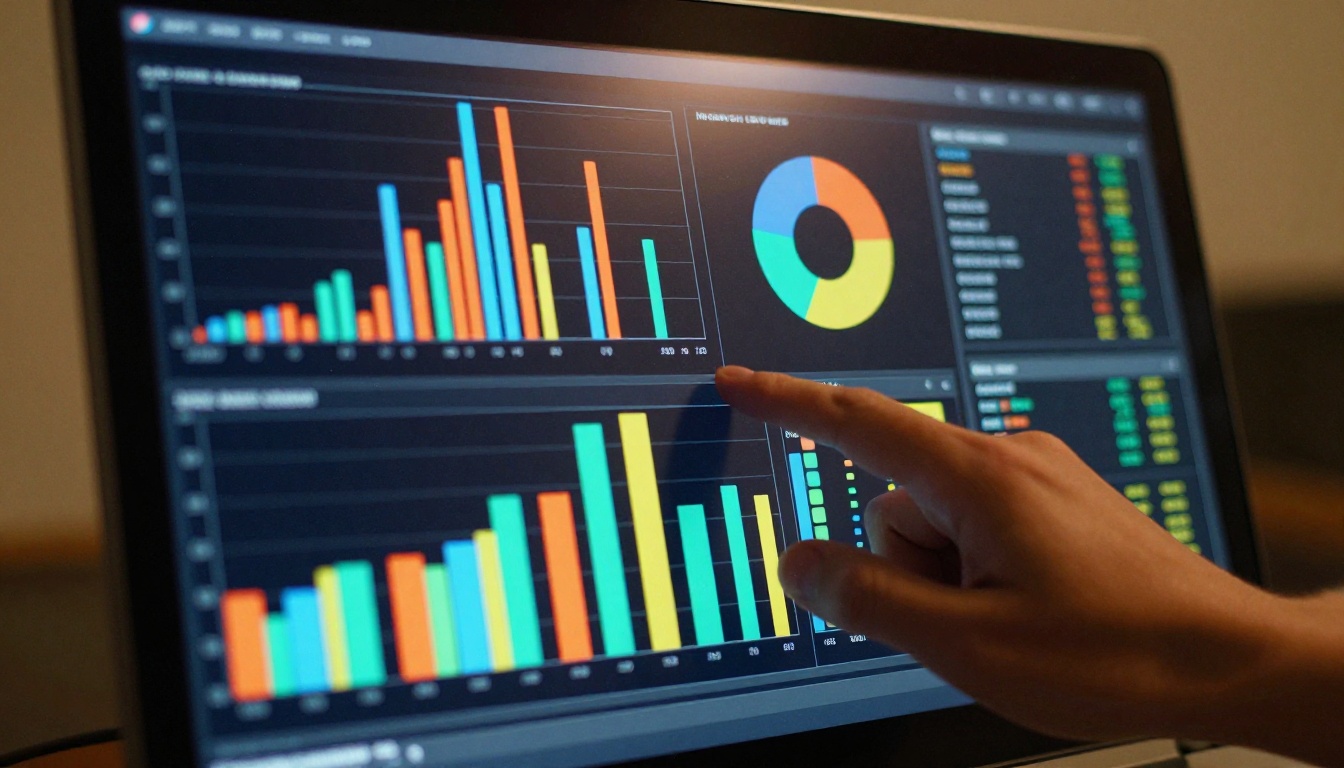
One of the more interesting workflows that GPT 5.5 enables is a two-stage pipeline: use it to interpret and summarize data in text, then hand that summary to a visual AI model to create presentation-ready imagery. For data storytelling, reports, and executive presentations, this combination produces outputs that would previously require a designer and an analyst working separately.
GPT 5.5 interprets the dataset and produces a clear narrative summary. That summary becomes the brief for an image generation model to create polished, contextually relevant visuals that match the report's theme. The result is a cohesive document in a fraction of the normal production time.
Models worth using alongside it
PicassoIA offers several LLMs that pair well with GPT 5.5 workflows, depending on your specific use case:
For structured data output and JSON formatting:
GPT 5 Structured is purpose-built for producing clean, machine-readable outputs. If your pipeline feeds AI outputs into another system, this model delivers consistent JSON without formatting drift.
For high-stakes reasoning on complex datasets:
GPT 5 Pro includes built-in extended thinking, which is valuable when the data question requires multi-step logical deduction rather than pattern matching. Think regulatory work, fraud pattern reasoning, or clinical decision support drafts.
For rapid iteration on large reports:
GPT 5.4 is the closest predecessor to 5.5 and handles long-document work well. If you are iterating quickly through multiple reports and do not need the full context window, 5.4 offers a strong balance of speed and depth.
For cost-effective first-pass work:
GPT 5 Mini is well-suited to preprocessing tasks: cleaning prompts, reformatting inputs, and running initial passes on data before escalating complex questions to a larger model.

What This Changes for Analysts
Data work has always had a bottleneck at the interpretation layer. Collecting and storing data became cheap. Running queries became accessible. But the step between "here are the numbers" and "here is what this means and what we should do" remained slow, human-intensive, and inconsistently executed across teams.
GPT 5.5 compresses that bottleneck without removing the human from the loop. It does not decide what matters. It does not set strategic priorities. But it dramatically accelerates the time from raw output to structured insight, which is the part of the process that was previously resistant to automation.

For teams that run regular reporting cycles, the time savings compound quickly. A weekly report that previously took a senior analyst 3 hours to draft can be reduced to 45 minutes when GPT 5.5 handles the initial interpretation, pattern flagging, and narrative. The analyst then focuses on the parts that actually require judgment.
Where the biggest time savings tend to appear:
- First-pass interpretation of new datasets: 60-80% faster
- Variance and exception reporting: 50-70% faster
- Narrative drafting for dashboards and reports: 40-60% faster
- Data quality audits on new data sources: 50-75% faster
Try It Now with PicassoIA
PicassoIA gives you direct access to the most capable GPT 5.x models without setup, API keys, or infrastructure overhead. Whether you want the structured output precision of GPT 5 Structured, the deep reasoning of GPT 5 Pro, or the long-document depth of GPT 5.4, it is all available in one place. No setup required.
Paste a dataset you already have: a sales report, a marketing attribution table, a cohort retention matrix. Ask it something you would normally spend an hour figuring out. The result will probably change how you think about the interpretation step. The gap between having data and actually making sense of it is smaller than it has ever been, and the models are ready right now.