There's a specific kind of frustration that comes from reading the same paragraph three times and still not getting it. Dense textbooks, jargon-filled research papers, legalese contracts, medical reports, financial disclosures — the world runs on complex language that most people weren't trained to decode. This is where AI changes everything. If you know how to use it, you can use AI to explain hard topics simply, in plain language, in seconds — not hours.
The skills required used to be either expensive (hire an expert) or time-consuming (read five books before the one you actually need). Now the path from confused to clear runs through a well-crafted prompt and a capable language model.

Why Hard Topics Stay Hard
The problem isn't that people aren't smart enough. It's that most written content is designed for specialists, not general readers. A cardiologist writes for other cardiologists. A machine learning researcher writes for an audience that already knows what a tensor is. A financial regulator writes policy documents for other regulators. When someone outside that group needs to understand the same material, there's no built-in bridge.
Traditional alternatives are slow and imperfect: find a YouTube video that may oversimplify, ask a friend who may not know enough, or hire a tutor who costs money and time. AI offers something none of those options do — an infinitely patient, always-available explainer that calibrates its language precisely to your level.

The cost of this problem is real. Poor comprehension of health information leads to worse medical decisions. Failure to understand financial instruments contributes to bad investment choices. Inability to parse legal documents means people sign things they don't fully understand. When you use AI to explain hard topics simply, you're not just satisfying curiosity — you're closing gaps that have real consequences.
There's also the confidence problem. People who regularly encounter topics they can't understand start to believe those topics are simply beyond them. AI breaks this cycle by proving, repeatedly, that almost anything can be explained clearly. The previous explanations were just bad, not the topic itself.
What AI Does When It Simplifies
Most people think AI "summarizes." That's not quite right. When you ask a well-designed large language model to explain something simply, it performs several simultaneous tasks:
- Identifies the core concepts buried in jargon
- Translates specialized vocabulary into everyday language
- Builds analogies connecting the unfamiliar to things you already know
- Strips redundancy without losing accuracy
- Reorders information by importance, not by academic convention
- Scaffolds complexity so simpler ideas come before advanced ones
💡 The best AI explanations don't dumb things down. They reframe complexity using simpler vocabulary while preserving the actual meaning.
This is what makes modern large language models so powerful for learning. They've been trained on vast amounts of text across every domain imaginable, which means they can draw analogies across fields — explaining how the immune system works using the metaphor of a security checkpoint, or explaining how a blockchain works using the concept of a shared public ledger that nobody owns but everyone can verify.
The key difference from a search engine is interaction. With search, you get a page. With a language model, you get a conversation partner who adapts. If the first explanation doesn't land, you ask differently. If you need more depth, you ask for it. If you want a simpler version, you get one. That feedback loop doesn't exist anywhere else at this speed.

The 5 Best AI Models for Breaking Down Hard Topics
Not all AI models are equally good at this. Some are faster but shallower. Others are slower but remarkably thorough. Here's a breakdown of the top performers currently available:
GPT 5 is consistently the top choice for complex explanations. Its ability to hold long context and produce structured, layered responses makes it ideal for anything from economics to molecular biology. Ask it to explain something at three different levels — beginner, intermediate, and expert — and all three come back with coherence and accuracy.
Claude 4 Sonnet excels at precision. When accuracy matters as much as clarity, Claude's careful and explicit reasoning style is hard to beat. It tends to flag uncertainty rather than guess, which builds appropriate trust in the output.
Deepseek R1 is a reasoning model that shows its work. For topics where the logic chain matters — mathematics, philosophy, formal argument, economics — this model walks through every step rather than jumping to a conclusion. This is invaluable when you need to understand why, not just what.
For quick reads and on-the-go clarification, Gemini 3 Flash delivers rapid responses without sacrificing basic accuracy. And for technical or code-related explanations, Kimi K2 Instruct is built specifically for that domain.

How to Write the Perfect Prompt
The model matters, but so does how you ask. Most people type something like "explain quantum physics" and get a Wikipedia-level response that doesn't quite hit the mark. Here's how to actually prompt for explanations that work.
Lead with your background
Tell the model who you are. "I'm a high school student with no science background" gives it a calibration point. "I have a business background but no technical training" signals which analogies will resonate and which assumptions to skip.
Specify the format you want
Bullet points, numbered steps, a comparison table, an analogy, a one-paragraph summary — these produce very different outputs. Be explicit about the structure you need before the model starts.
Ask for an analogy
This is the single most underused prompt technique. Adding "use a real-world analogy" almost always produces a more memorable, more usable explanation than a straight definition. Analogies stick in a way that definitions rarely do.
Request multiple complexity levels
"Explain this at three levels: like I'm 10, like I'm a college student, and like I'm a professional in the field." This gives you a gradient you can use to find exactly where your understanding sits — and then continue from there.
💡 Prompt template that works: "Explain [TOPIC] to someone with no background in [FIELD]. Use a real-world analogy, keep it under 200 words, and avoid jargon unless you define it immediately."
Follow up with "Why does this matter?"
Context is often what's missing from technical explanations. Once you understand the mechanics, ask why anyone cares. This connects the abstract to something meaningful and helps it stick beyond the conversation.
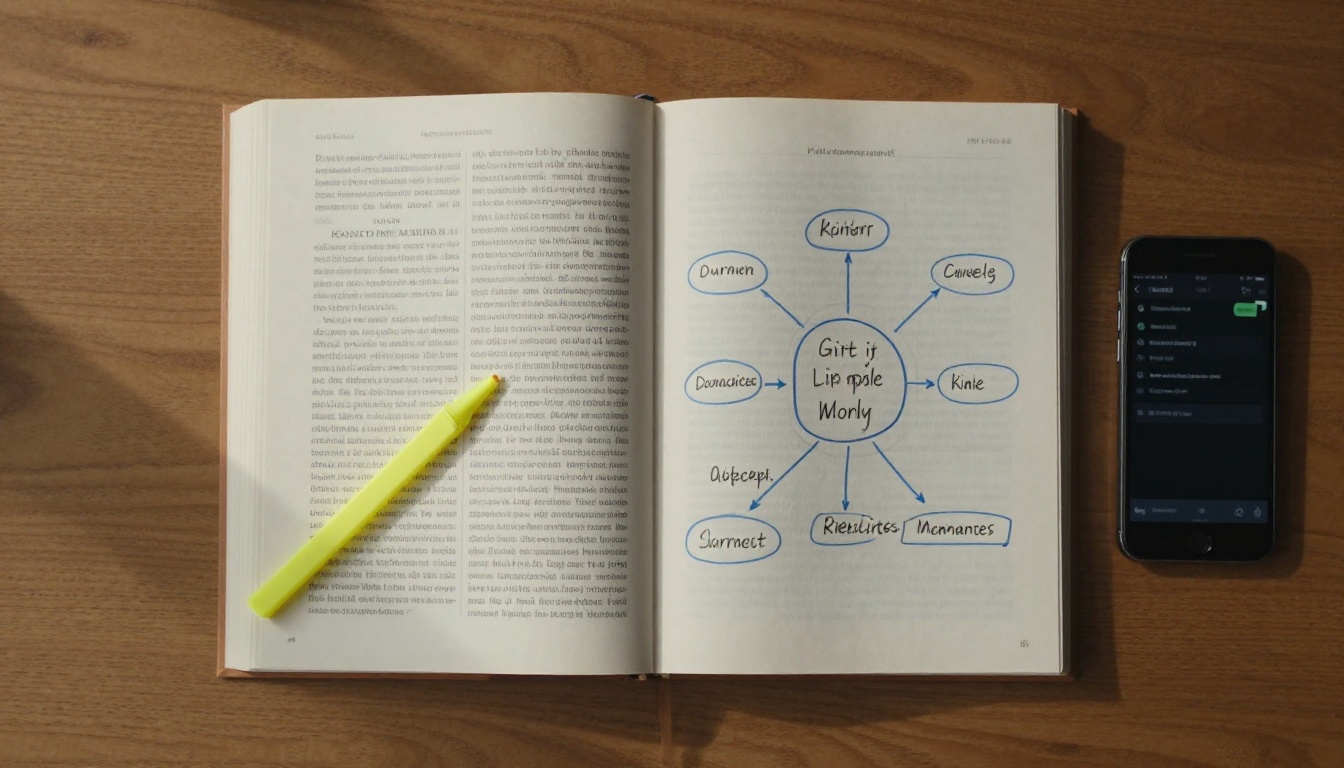
Use the "five-year-old test" deliberately
The classic "explain it like I'm five" prompt works for a reason. It forces the model to abandon jargon entirely and surface the absolute core concept. It's not always the explanation you'll use in practice, but it always reveals whether the AI actually understands the topic — or is just pattern-matching to technical vocabulary.
Real-World Use Cases That Work Right Now
This isn't theoretical. Here are specific, practical scenarios where using AI to explain hard topics simply delivers immediate, measurable results.
For students
Paste a dense paragraph from a textbook and ask: "Rewrite this in plain English, then give me two concrete examples that illustrate the main concept." This converts passive reading into active understanding and turns confusion into a starting point for real questions.
For professionals crossing into unfamiliar territory
Encountering an unfamiliar legal clause? Medical report with terminology you don't recognize? Financial instrument you've never heard of? Paste the text and ask the AI to explain what it means in practical terms — what it actually means for you, in your specific situation.

For researchers working across disciplines
When you're working across fields, you constantly hit vocabulary walls. AI bridges those gaps in seconds rather than requiring you to locate and read an entire introductory textbook. A neuroscientist reading an economics paper, or an engineer reading a policy brief, can get the context they need immediately without losing momentum.
For teachers and trainers
Use AI to generate simplified explanations at multiple reading levels, then compare them. This raw material can be adapted for different learners in your class or team without spending hours writing from scratch. It's also a useful diagnostic: if the AI can't explain something simply, the source material may be unusually complex or internally inconsistent.
For curious people without a specific agenda
Sometimes you read a news story that references something you don't understand — a financial instrument, a political concept, a scientific finding. AI turns that passing curiosity into actual knowledge immediately, with no friction and no embarrassment about asking a "basic" question.
How to Use LLMs on PicassoIA to Simplify Any Topic
PicassoIA hosts a comprehensive suite of powerful large language models, all accessible without needing separate accounts or subscriptions for each one. Here's exactly how to use them for topic simplification.
Step 1: Choose your model. Navigate to the Large Language Models collection and select based on your needs. For general simplification, GPT 5 or Claude 4 Sonnet are strong starting points. For deep reasoning on complex logical or mathematical topics, start with Deepseek R1.
Step 2: Open the model interface. Each model page includes a direct chat interface. No setup, no API keys, no configuration required — just open and type.
Step 3: Paste your content and your prompt together. Paste the text you want simplified, then add your specific instructions directly below it. This keeps the full request in one block and gives the model complete context to work with.
Step 4: Specify your output format. Ask explicitly for bullet points, a short paragraph, a comparison table, or an analogy. Without this, most models default to a generic essay format that may not be what you need.
Step 5: Iterate. The first response is a starting point, not a final answer. Ask follow-up questions: "Can you give me a more specific example?" or "What would be the main argument against this?" or "Now explain just the part about [specific term] in more detail."

You can also access models like Grok 4 for particularly thorny logical problems, or Llama 4 Maverick Instruct for fast, capable responses on general knowledge topics. The breadth of the collection means you can switch models mid-session if the first one isn't delivering the depth or style you need.
💡 Pro tip: For very long documents — legal contracts, academic papers, policy documents — models with large context windows like GPT 4o or Claude Opus 4.7 handle the full text without losing important context from the beginning of a long document.
3 Mistakes People Make When Asking AI to Explain Things
Even with great models, bad habits produce bad results. These are the three patterns that consistently lead to unhelpful explanations.
Asking too broadly
"Explain machine learning" produces a textbook overview. "Explain why overfitting happens when training a model, using a cooking analogy" produces something specific and immediately usable.
The fix: Always narrow the scope. Identify the single thing you actually don't understand, not the entire field around it.
Not specifying your background
The same question gets wildly different responses depending on how you frame your knowledge level. Without context, the model defaults to a generic middle ground that often misses both beginners and specialists.
The fix: Always include "I have a background in [X] but no experience with [Y]" before your question.
Accepting the first answer without pushing
AI explanations are a starting point, not a conclusion. The real value comes from the follow-up exchange. "That's helpful, but I still don't understand the part about [specific thing]. Can you go deeper there?"
The fix: Treat the first response as the opening of a conversation, not the end of one.

What Makes a Good AI Explanation
Not every AI-generated explanation is worth keeping. Here's how to evaluate what you're getting:
- Accuracy first. A simple explanation that's wrong is worse than a complex one that's right. Cross-check anything critical with a primary source.
- Analogies should match your world. The best analogies use things you already know intimately. If an analogy doesn't click, ask for a different one from a different domain.
- Specificity beats generality. "This reduces the body's ability to absorb calcium by blocking receptor sites in the small intestine" is more useful than "this affects how your body processes nutrients."
- Structure matters. Good explanations build progressively — each sentence prepares you for the next rather than dropping you into complexity without scaffolding.
- It invites follow-up. A great explanation opens more questions than it closes. If you read an AI explanation and have nothing left to ask, it probably oversimplified.
💡 If an AI explanation still feels unclear after reading it once, don't reread it. Ask a more specific follow-up question instead. Reading an unclear explanation a second time almost never produces clarity.
Put It to Work

The gap between what you currently understand and what you want to understand has never been smaller. Pick one topic that's been sitting at the edge of your comprehension — a concept from a podcast you half-followed, a technical term in a job description that confused you, a clause in a contract you signed without fully reading.
Open any of the large language models available on PicassoIA, paste your question with a clear and specific prompt, and see what comes back. Then push it further with a follow-up. That's the practice: not asking once, but building a back-and-forth that takes you from confused to clear, on your schedule, without needing anyone else in the room.
The models are available right now. The method works. What's your first question?


