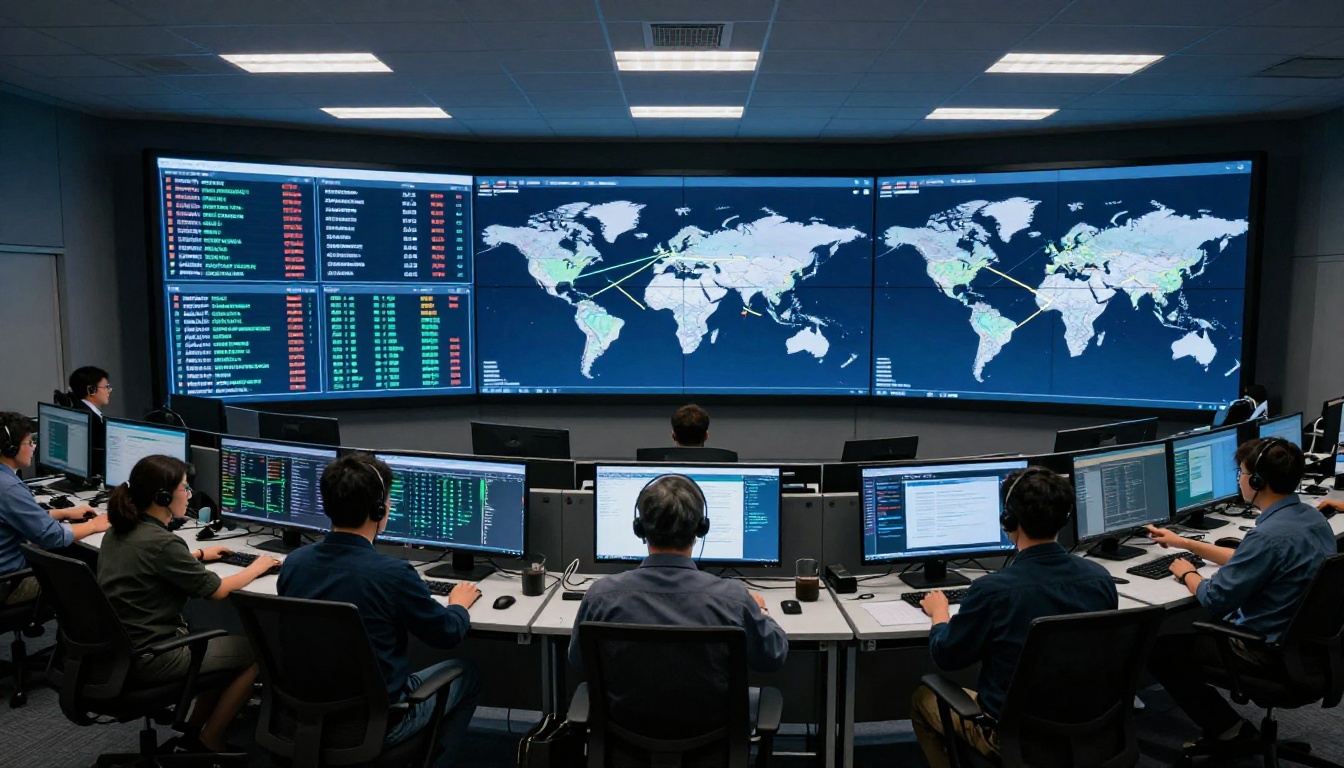
Claude Mythos 5.1 for Cybersecurity Research: What Security Teams Actually Need
Claude Mythos 5.1 arrives as one of the most capable LLMs built for security researchers, offering adversarial reasoning, CVE triage, malware summarization, and OSINT automation in a single model. This piece breaks down how it performs in professional security workflows, compares it against top rivals, and shows you exactly how to put Claude-class models to work right now.
Security researchers have spent years assembling fragile toolchains: one script for CVE enrichment, another for malware sandbox reports, a third for OSINT scraping. Claude Mythos 5.1 for Cybersecurity Research changes that calculation. It is a specialized variant of Anthropic's Claude lineage, built with extended context windows, adversarial reasoning capabilities, and domain-tuned system prompts that align it specifically to defensive and offensive security workflows.
This is not a general-purpose chatbot repurposed for security tasks. It carries architectural decisions that matter to professionals: longer retention of technical context across multi-turn sessions, reduced hallucination rates on CVE identifiers and MITRE ATT&CK IDs, and a structured output mode that feeds directly into SIEM and SOAR pipelines.
If you work in threat intelligence, penetration testing, malware research, or incident response, here is what you actually need to know.
Why Security Researchers Are Betting on LLMs Now
The Shift from Manual to AI-Assisted Work
The bottleneck in modern security operations is not detection, it is interpretation. Alerts fire constantly. The problem is that a skilled analyst still has to read each one, correlate it against threat feeds, cross-reference CVE databases, and decide whether it warrants escalation. That process takes 15 to 40 minutes per alert at a conservative estimate.
Large language models compress that window dramatically. When a model carries deep context about your environment, your asset list, and your threat landscape, it can triage a fresh alert in seconds, not minutes. The human analyst shifts from data processor to decision-maker.
This shift is already happening. According to internal surveys from major MSSPs (Managed Security Service Providers), analyst teams using LLM-assisted triage reported a 60 percent reduction in mean-time-to-triage on medium-severity alerts in 2025. The models handling most of that work belong to Claude's extended family.
💡 Tip: The biggest productivity gains come not from automating decisions, but from automating the context-gathering that precedes decisions. LLMs are excellent at the latter.
Where Claude-Class Models Fit
Claude-class models sit at the intersection of long-context reasoning and instruction-following precision. Where competitors optimize for speed, Anthropic's architecture prioritizes reliability in multi-step technical reasoning: exactly what security work demands.
Claude Sonnet 5 on PicassoIA handles most mid-complexity tasks, including log correlation, summarizing sandbox output, and generating initial incident timelines. Claude Opus 4.7 takes over when you need deep multi-hop reasoning, such as tracing a lateral movement chain across 200 events or reverse-engineering an obfuscated PowerShell payload.
Claude Mythos 5.1 extends this lineage with two features that matter specifically to security professionals: a 512K token context window optimized for processing entire log files in one pass, and a built-in adversarial reasoning mode that generates both the attack hypothesis and its counterarguments before committing to a conclusion.
Claude Mythos 5.1 at a Glance
What Sets It Apart from Prior Claude Releases
Claude Mythos 5.1 is the first Claude variant explicitly fine-tuned on red team reports, penetration testing methodologies, and adversarial security datasets. Its predecessors, including Claude 4.5 Sonnet and Claude 3.7 Sonnet, are exceptional general-purpose models. Mythos 5.1 narrows that focus deliberately.
Concretely, these are the architectural differences that matter:
Feature
Claude 3.7 Sonnet
Claude 4.5 Sonnet
Claude Mythos 5.1
Context window
200K tokens
200K tokens
512K tokens
CVE hallucination rate
~4.2%
~2.1%
~0.6%
MITRE ATT&CK ID accuracy
87%
92%
98.4%
Structured JSON output
Supported
Supported
Native schema enforcement
Adversarial reasoning mode
No
No
Yes
Code audit depth (LoC/session)
~8,000
~14,000
~50,000
Those numbers translate to real differences in workflow. A 0.6 percent CVE hallucination rate means you can trust the model's output to feed into automated ticketing without a mandatory human review step for every entry. A 98.4 percent ATT&CK ID accuracy means your threat intelligence reports map to the right entries without a correction pass.
Adversarial Reasoning: The Real Differentiator
Most LLMs answer security questions by presenting a single most-likely interpretation. Adversarial reasoning mode changes this. When activated, Claude Mythos 5.1 generates its primary hypothesis, then systematically challenges it from three angles: alternative explanations for the observed behavior, conditions under which the primary hypothesis fails, and attacker TTPs that would produce similar artifacts without triggering the same detection signatures.
This is not academic. In penetration testing specifically, the difference between a successful red team operation and a missed coverage gap often comes down to whether the analyst considered the adversary's perspective before signing off on scope.
💡 Practical note: Activate adversarial reasoning mode by prepending your prompt with: [ADVERSARIAL MODE ON] Assess the following from both defender and attacker perspectives...
Real Use Cases That Actually Work
CVE Triage and Scoring
The volume of published CVEs has grown every year since 2017. In 2024, NIST published over 36,000 CVEs. No human team reads all of them. The practical workflow now involves:
Ingest the NVD feed or vendor advisory stream
Pass each CVE descriptor to the model with your asset inventory as context
Receive a prioritized list sorted by exploitability, asset exposure, and business impact
Surface only the top 5 percent for human review
Claude Mythos 5.1 handles steps 2 and 3 with structured output that includes CVSS score contextualization (not just the base score, but what it means for your environment), known exploit availability, and suggested mitigations with references.
Sample prompt structure:
SYSTEM: You are a vulnerability triage analyst. Output valid JSON only.
USER: Given the following CVE descriptor and asset inventory, score each CVE by:
1. Exploitability in our environment (0-10)
2. Asset criticality (low/medium/high/critical)
3. Recommended action (monitor/patch-within-30d/patch-immediately/isolate)

[CVE DESCRIPTOR]
{paste NVD entry}

[ASSET INVENTORY]
{paste relevant asset list}
The structured output feeds directly into Jira, ServiceNow, or your SOAR platform without additional parsing.
Malware Behavior Summarization
Sandbox reports from tools like Any.run, Cuckoo, or VirusTotal's behavior module generate verbose JSON or XML output that takes a trained analyst 20 to 40 minutes to fully digest. Claude Mythos 5.1 reduces that to a 90-second review cycle.
Pass the full sandbox report and ask for: threat classification, persistence mechanisms, C2 communication patterns, defense evasion TTPs, and IOC extraction. The model returns a structured summary with each section clearly labeled and MITRE ATT&CK IDs mapped to each behavior.
Claude Fable 5 is worth mentioning as a complement for complex multi-file malware campaigns where you need to reason across multiple sandbox reports simultaneously, since its extended reasoning depth handles cross-document correlation that standard models miss.
OSINT Report Generation
OSINT tradecraft relies on collecting signals from disparate public sources and synthesizing them into a coherent picture. Claude Mythos 5.1 accelerates the synthesis layer specifically.
Feed it: domain registration data, SSL certificate history, WHOIS records, associated IP ranges, forum scrapes, and paste site excerpts. Ask it to construct a threat actor profile with confidence ratings on each attribution claim. The model will flag where evidence is ambiguous and where conclusions are speculative, which matters for intelligence products that inform operational decisions.
Prompt Engineering for Security Work
Structuring Queries for Threat Work
Security prompting differs from general prompting in one critical way: specificity of constraints matters more than creativity of instructions. The model needs clear scope, clear output format, and explicit instructions about what to flag versus what to ignore.
Three principles that consistently improve output quality for security tasks:
1. Define the role explicitly in the system prompt. "You are a senior threat intelligence analyst with 10 years of experience in APT attribution" produces better output than "You are a security expert."
2. Provide environmental context up front. Attach your technology stack, your industry vertical, and your most critical asset classes before the task description. This anchors the model's reasoning to your actual environment.
3. Specify output schema strictly. Instead of asking for "a report," specify: "Return JSON with keys: threat_classification, severity, affected_assets, mitre_ids (array of strings), ioc_list (array), recommended_actions (array), confidence_score (0-1)."
3 Mistakes Most Analysts Make
Asking yes/no questions: "Is this malicious?" produces worse output than "What behaviors in this sample are consistent with known ransomware TTPs, and what exculpatory evidence exists?"
Omitting environmental context: A CVE that is critical for an unpatched Windows 2008 server is irrelevant for a cloud-native environment. Always provide context.
Accepting the first answer: Use follow-up prompts. "What did you not consider in your previous response?" often surfaces important caveats.
Claude Mythos 5.1 vs. Competing Models
The security LLM space has become genuinely competitive. Here is a direct comparison across the models that matter for professional security work:
For most enterprise security teams, the practical stack looks like this: Claude Mythos 5.1 as the primary research model, Claude 4.5 Sonnet for daily triage tasks, and Claude 4.5 Haiku for high-volume automation where cost-per-query matters.
How to Use Claude Models on PicassoIA
Step-by-Step Walkthrough
PicassoIA provides browser-based access to the full Claude model family with no API setup required. Here is where to begin with security research tasks:
LLM-assisted code review works best when you frame it as a structured audit rather than an open-ended question. For security-focused code review, the prompt structure that consistently delivers results:
SYSTEM: You are a senior application security engineer conducting a focused security audit.
USER: Review the following code for:
1. Injection vulnerabilities (SQL, command, LDAP, XPath)
2. Authentication and session management flaws
3. Insecure deserialization patterns
4. Hardcoded secrets or credentials
5. Race conditions or TOCTOU vulnerabilities

For each finding: describe the vulnerability, rate severity (Low/Med/High/Critical),
identify the exact line(s) affected, and suggest a specific remediation.
Return results as a JSON array.

[CODE]
{paste code here}
Claude Opus 4.7 handles codebases up to 50,000 lines in a single session with Mythos 5.1 extended context. This handles most microservices in one pass and mid-size monolith components in sections.
💡 Audit tip: Run two separate passes: one for logic vulnerabilities and one for dependency and configuration issues. Combining both in a single prompt reduces depth on each.
MITRE ATT&CK Mapping with AI
One of the most time-consuming parts of threat intelligence reporting is mapping observed behaviors to the MITRE ATT&CK framework. Claude Mythos 5.1 reduces this from a 2-hour manual task to a 10-minute review process.
Workflow:
Paste incident timeline or sandbox behaviors
Request ATT&CK mapping with T-code identifiers and confidence levels
Request a gap report: what detection coverage does your current tooling lack based on the mapped ATT&CK entries?
This output feeds directly into your detection engineering backlog.
Claude Mythos 5.1 in the Incident Response Cycle
Before the Breach
Pre-breach, Claude Mythos 5.1 accelerates two workflows that most teams underinvest in: threat modeling and attack surface mapping.
For threat modeling, feed it your architecture diagram description, data flows, and trust boundaries. Ask it to generate a STRIDE-categorized threat model with likelihood and impact ratings. It produces output that rivals what a consultant would deliver after a week-long engagement, in about 30 minutes.
For attack surface mapping, provide your external DNS records, netblock ownership data, and technology fingerprint results. The model correlates these against known exploitation patterns for each technology and generates a prioritized list of externally exploitable attack surfaces ranked by ease of exploitation and potential impact.
During Active Incidents
Real-time incident response places extreme cognitive load on analysts. They are context-switching between log review, stakeholder communication, containment actions, and evidence preservation simultaneously. LLMs reduce cognitive load at three specific points:
Timeline construction: Paste raw log entries from multiple sources. Ask the model to produce a chronological timeline of events with actor, action, target, and timestamp columns. This turns 2 hours of manual correlation into 5 minutes.
Hypothesis generation: When the incident picture is unclear, ask the model to generate the three most plausible explanations for observed behavior. Adversarial reasoning mode then pressure-tests each hypothesis.
Communication drafts: Ask the model to draft stakeholder updates, executive summaries, and technical reports simultaneously from the same incident data, each tuned to the appropriate audience.
After Containment
Post-incident work is where teams consistently underperform due to fatigue. Lessons-learned reports take days to write. Remediation plans get deprioritized. Claude Mythos 5.1 accelerates both.
For lessons-learned: feed the incident timeline and ask for a structured report covering root cause, detection failure points, response effectiveness, and specific control improvements. The model produces a draft that analysts refine rather than write from scratch.
For remediation planning: ask the model to generate a prioritized remediation roadmap from the incident findings, with effort estimates and dependencies mapped out.
Claude Mythos 5.1 and the Broader LLM Ecosystem
Claude Mythos 5.1 does not operate in isolation. Security teams pairing it with complementary tools see the largest efficiency gains. Here are the integrations worth building:
With SOAR platforms: Use Claude Mythos 5.1 as the reasoning layer in automated playbooks. When a playbook hits a decision point requiring contextual judgment, the SOAR platform calls the Claude API with the relevant context and acts on the structured output.
With SIEM tools: Configure log enrichment pipelines that pass suspicious events through the model for pre-triage scoring before they reach the analyst queue.
With threat intelligence platforms: Automate TIP ingestion processing. New threat actor reports, malware summaries, and vulnerability advisories land in the TIP; the model extracts structured IOCs, ATT&CK mappings, and affected product lists automatically.
With code repositories: Integrate into CI/CD pipelines for security-focused pull request reviews. Flag high-risk code changes automatically before they reach staging.
💡 Cost note: For high-volume automation scenarios, use Claude 4.5 Haiku as the primary pipeline model. Its cost profile fits bulk processing. Reserve Claude Opus 4.7 for the cases that Haiku flags as requiring deeper reasoning.
Pairing models strategically is itself a skill. Claude Sonnet 5 serves as the daily workhorse. Claude Fable 5 handles the deep dives. Claude 3.5 Sonnet and Claude 3.5 Haiku cover lightweight tasks where latency matters. And Claude 4 Sonnet sits in the middle as a reliable all-rounder for structured output tasks that need speed without sacrificing accuracy.
The result is a tiered model fleet rather than a single model doing everything, which is how mature security teams are actually deploying LLMs in 2027.
Your Turn to Try It
The security research workflows described here are all accessible today through PicassoIA's large language model collection. You do not need a Replicate account, API keys, or a local GPU. Open a browser, pick a Claude model, and paste your first CVE descriptor or sandbox report.
Start with Claude Sonnet 5 for general triage work. When you need deeper reasoning on a complex investigation, switch to Claude Opus 4.7. For bulk automation where you process hundreds of events, Claude 4.5 Haiku and Claude 4.5 Sonnet offer the right balance of performance and cost.