AI Music Generators That Sound Like Grammy Winners: The Professional-Grade Tools
The music industry is being transformed by AI tools that can now create compositions indistinguishable from award-winning tracks. This guide examines the professional-grade AI music generators available today, focusing on their ability to produce Grammy-level quality. We'll explore the technical capabilities of top platforms, compare their outputs, and show how musicians are using these tools to enhance their creative workflows. From vocals to complete orchestrations, discover which AI music tools deliver studio-ready results.
The professional music industry has reached an inflection point. For years, AI music generation tools produced amateurish results that no serious musician would consider using in professional work. Today, that's changed dramatically. We now have AI music generators that produce Grammy-worthy compositions—tracks with the production quality, emotional depth, and technical sophistication that can compete with award-winning music.
What Makes Grammy-Quality Music Different
The Technical Benchmarks of Award-Winning Tracks
Grammy-winning music isn't just about catchy melodies or emotional lyrics—it's about technical excellence that stands up to professional scrutiny. When engineers at major labels evaluate tracks, they're looking at:
Technical Parameter
Professional Standard
Amateur Telltales
Dynamic Range
12-16 dB RMS
<8 dB (over-compressed)
Frequency Balance
Even distribution 20Hz-20kHz
Missing lows/highs
Stereo Imaging
Precise, stable placement
Phase issues, collapse
Noise Floor
<-90 dBFS
>-60 dBFS
Transient Response
Crisp, defined attacks
Smeared, muddy
💡 Professional Insight: Grammy-winning tracks maintain perfect balance across the entire frequency spectrum. They sound excellent on everything from $50,000 monitoring systems to smartphone speakers—a test most amateur productions fail immediately.
Production Values That Separate Pros from Amateurs
The difference isn't just technical; it's artistic and experiential. Professional productions have:
Intentional space management (reverb, delay choices)
Consistent emotional arc across the entire track
Professional arrangement that serves the song, not the ego
Reference-grade mixing that works in all listening environments
Why AI Struggled with Quality Until Recently
Early AI music tools focused on melody generation or simple pattern creation, missing the critical components of professional music: arrangement, production, and mixing. The breakthrough came when models started understanding:
Music as a complete production, not just notes
The relationship between instruments in professional arrangements
How effects and processing create emotional impact
The importance of genre conventions and their exceptions
The Top AI Music Generation Platforms
How Music-01 Creates Instant Vocals and Instrumentals
The Music-01 model on PicassoIA represents a significant leap in AI music technology. Unlike previous tools that generated MIDI or simple melodies, Music-01 creates complete musical productions with vocals in under a minute.
Key capabilities:
Generate music with custom lyrics and vocals
Mimic any reference track's style and arrangement
Support for voice and instrumental reference files
Flexible bitrate and sample rate options (up to 320 kbps)
A cappella or instrumental-only output
💡 Production Tip: Use Music-01 for demo creation and songwriting assistance. The ability to generate complete vocal tracks means songwriters can test arrangements before expensive studio sessions.
Stable-Audio-2.5's Studio-Quality Soundscapes
Stable-Audio-2.5 from Stability AI focuses on text-to-music generation with studio-grade quality. This model excels at creating:
Cinematic scores and soundscapes
Ambient background music for media
Genre-specific productions with accurate instrumentation
Customizable duration (seconds precision)
Technical advantages:
Adjustable diffusion steps for quality control
Configurable guidance scale for prompt adherence
Reproducible outputs via seed input
Professional-grade audio encoding
Music-1.5's Full-Length Song Capabilities
For those needing complete song productions, Music-1.5 generates full-length tracks up to 4 minutes with:
Natural vocals that avoid the "AI voice" artifact
Rich instrumentals with professional arrangement
Customizable lyrics and music style prompts
Multiple output formats: MP3, WAV, or PCM
What sets Music-1.5 apart:
Song structure understanding (verse, chorus, bridge)
Dynamic arrangement that builds appropriately
Emotional consistency throughout the track
Professional mixing decisions baked into generation
Lyria-2's High-Fidelity 48kHz Stereo Output
Google's Lyria-2 delivers what many consider the highest audio quality currently available in AI music generation:
48kHz stereo audio from text prompts
Fine-tune with negative prompts to exclude unwanted elements
Random or fixed seeds for varied or reproducible outputs
Fast production of original music and soundscapes
The 48kHz advantage matters because:
It captures higher frequency content (up to 24kHz)
Provides better temporal resolution for transients
Allows more headroom for professional processing
Meets broadcast and streaming platform requirements
Technical Specifications That Matter
Bitrate, Sample Rate, and Audio Quality Explained
When evaluating AI music quality, understanding these technical terms is essential:
Bitrate determines file size and compression artifacts:
128 kbps: Acceptable for streaming, noticeable artifacts
192 kbps: Good balance for most listening
256 kbps: Near-transparent, used by premium services
320 kbps: Essentially lossless for most listeners
Sample Rate affects frequency range and temporal accuracy:
44.1kHz: CD standard, captures up to 22.05kHz
48kHz: Professional video/audio standard, up to 24kHz
96kHz: High-resolution, minimal practical benefit for most
192kHz: Ultra-high-resolution, mainly for archival
The Role of Diffusion Steps in Music Generation
Diffusion models (used by Stable-Audio-2.5 and others) work by:
Starting with random noise
Gradually removing noise toward the target
Using conditioning information (your prompt) to guide the process
More diffusion steps generally mean:
Higher quality output
Longer generation time
Better prompt adherence
More computational cost
💡 Practical Advice: Start with default settings, then adjust based on results. Too many steps can lead to over-processed sounds, while too few may lack definition and clarity.
How Prompt Engineering Affects Musical Output
Prompt quality directly correlates with output quality. Professional users have developed these strategies:
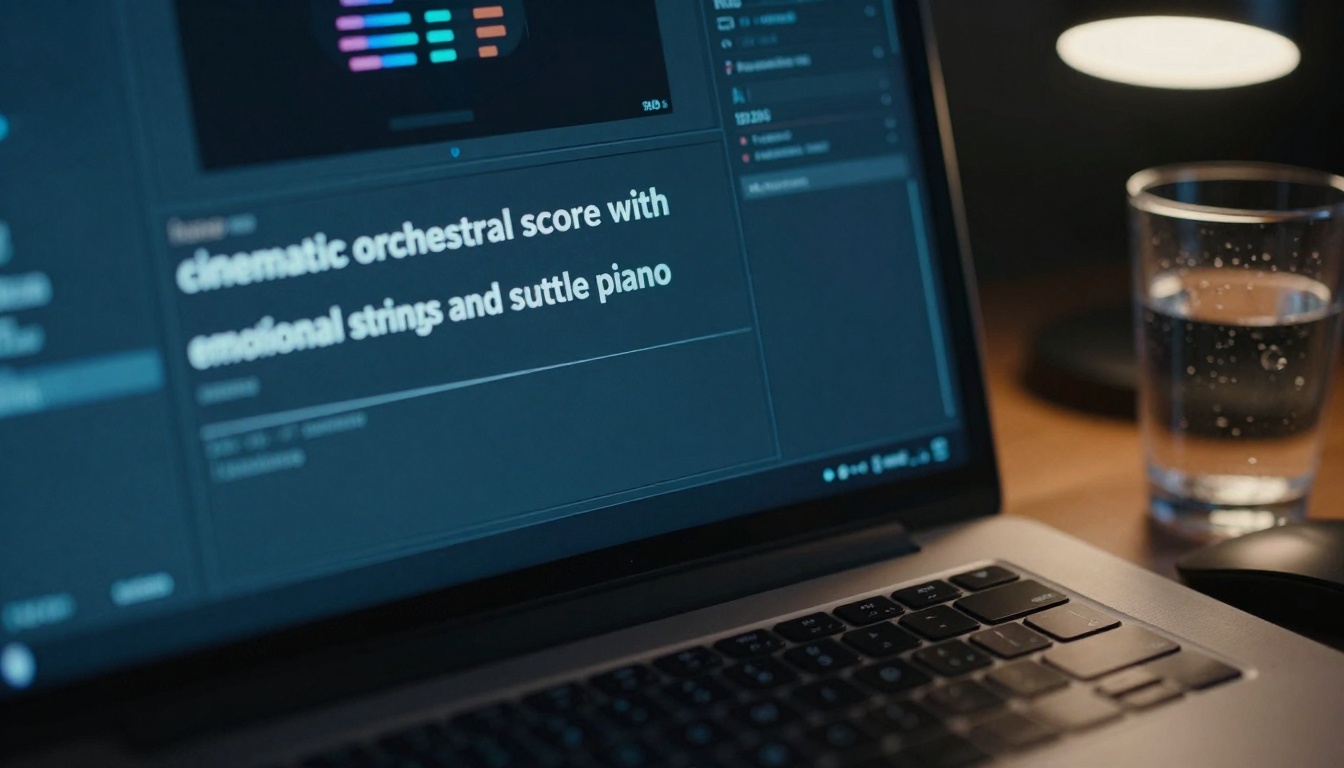
Cinematic orchestral score with emotional string arrangements and subtle piano accompaniment, moderate tempo, professional film scoring production with wide stereo imaging and controlled reverb
Common prompt mistakes:
Too vague: "happy music" (what genre? instruments?)
Professional users report these common beginner errors:
Technical mistakes:
Accepting first generation (always generate multiple versions)
Ignoring output settings (always use highest quality available)
Skipping post-production (AI output needs professional processing)
Creative mistakes:
Over-specific prompts (allow some AI creativity)
Genre confusion (pick one primary genre, not fusion)
Ignoring references (use style references when available)
Resources for Learning Advanced Techniques
The professional AI music community shares knowledge through:
Online communities:
Producers using AI forums and Discord servers
Platform-specific user groups (PicassoIA community)
Professional organization discussions (AES, NAMM)
Educational resources:
Platform documentation (often includes advanced tips)
Professional tutorials from working producers
Academic papers on music AI advancements
The most important resource: Your own experimentation. Start with small projects, learn what each model does well, and develop your personal workflow that combines AI efficiency with human creative judgment.
Ready to explore what AI music generation can do for your creative work? The tools on PicassoIA's AI Music Generation platform offer professional-grade capabilities that were science fiction just a few years ago. Start with a simple prompt, listen to the results with critical ears, and discover how these tools can accelerate your creative process while maintaining—or even enhancing—the professional quality your work deserves.
The intersection of human creativity and AI capability represents one of the most exciting developments in music technology history. Whether you're a professional producer looking to streamline workflows, an independent artist expanding creative possibilities, or a music educator preparing students for the future, these tools offer genuine professional value.