The landscape of free AI chat tools has expanded dramatically, with two standout models now accessible without subscription barriers: Grok 4 from xAI and Claude Opus 4.5 from Anthropic. Both represent cutting-edge language model technology, yet they approach conversation with distinctly different philosophies. For users seeking powerful AI assistance without financial commitment, understanding these differences isn't just academic—it's practical. The right choice can transform how you research, create, and solve problems daily.

The intimacy of mobile AI chat: Grok's bold red interface contrasts with Claude's refined blue tones
What Grok 4 and Claude Opus 4.5 Actually Offer
At their core, both models provide sophisticated language understanding and generation capabilities. Grok 4 (available on PicassoIA) brings Elon Musk's xAI approach to conversational AI: direct, sometimes irreverent, and optimized for real-time interaction. The model emphasizes speed and accessibility, with a personality that feels more like talking to a knowledgeable but casual expert than a formal assistant.
Claude Opus 4.5 (available on PicassoIA) represents Anthropic's continued refinement of their Constitutional AI approach. This model prioritizes safety, accuracy, and nuanced understanding, often delivering responses that feel carefully considered and thoroughly reasoned. Where Grok might jump quickly to conclusions, Claude tends to explore multiple angles before committing to an answer.
💡 Free access reality check: Both models offer substantial capabilities without payment, but with reasonable usage limits. Grok 4 typically provides more generous daily quotas for free users, while Claude Opus 4.5 focuses on delivering high-quality responses within more constrained free tiers.
The technical specifications reveal their philosophical differences:
| Aspect | Grok 4 | Claude Opus 4.5 |
|---|
| Response Style | Direct, concise, sometimes humorous | Detailed, nuanced, thoroughly explained |
| Speed | Typically faster initial responses | Slightly slower but more comprehensive |
| Context Window | Large but optimized for conversation flow | Exceptionally large with strong memory |
| Creative Approach | Bold, imaginative, willing to experiment | Careful, structured, methodically creative |
| Technical Depth | Practical solutions, less theory | Deep theoretical foundations included |
| Safety Approach | More permissive within bounds | Conservative with strong safeguards |
Research mode: comparing AI responses side-by-side reveals their distinct approaches to the same problems
The Personality Divide: Bold vs Refined
The most immediate difference users notice is personality. Grok 4 converses with a distinctive voice—confident, occasionally sarcastic, and unafraid to express strong opinions. This isn't the detached neutrality of earlier AI models; it's a character with clear preferences and perspectives. For users who want an AI that feels like a real conversation partner rather than a sterile tool, this personality can be engaging and motivating.
Claude Opus 4.5 maintains Anthropic's signature thoughtful tone. Responses feel like they've been carefully crafted by someone who values precision and completeness. The model demonstrates what they call "constitutional" behavior—consistently aligning with principles of helpfulness, honesty, and harm avoidance. This creates a different kind of trust: not the trust of personality alignment, but the trust of predictable, principled behavior.
Three key personality observations emerge:
-
Risk tolerance: Grok 4 shows higher willingness to entertain speculative or unconventional ideas. Claude Opus 4.5 demonstrates more caution, preferring established approaches unless specifically asked to innovate.
-
Explanation style: When explaining complex concepts, Grok 4 uses analogies and simplified models. Claude Opus 4.5 provides more systematic, step-by-step explanations that build from fundamentals.
-
Error handling: Grok 4 might confidently state incorrect information that needs correction. Claude Opus 4.5 more frequently qualifies statements with confidence levels and acknowledges uncertainty.

The tactile experience: typing queries while monitors reflect ongoing AI conversations
Testing Creative Writing Capabilities
Creative tasks reveal fundamental differences in how these models approach imagination and expression. Grok 4 excels at generating content with strong voice and personality. When asked to write a short story, blog post, or marketing copy, the output often reads like it was written by someone with distinctive style preferences—perhaps too distinctive for some applications, but memorable and engaging.
Claude Opus 4.5 produces writing that feels more polished and professionally structured. The model demonstrates stronger understanding of narrative structure, character development, and thematic consistency. For longer-form creative projects, Claude's output often requires less editing to achieve publishable quality, though it may lack the distinctive spark that Grok sometimes provides.
Specific creative writing tests show clear patterns:
-
Poetry: Grok 4 produces more experimental, free-form poetry with unusual metaphors. Claude Opus 4.5 creates more traditionally structured verse with careful attention to meter and rhyme.
-
Dialogue writing: Grok 4 generates snappier, more natural-sounding dialogue with distinctive character voices. Claude Opus 4.5 produces dialogue that advances plot and character development more systematically.
-
Marketing copy: Grok 4 creates attention-grabbing headlines and energetic descriptions. Claude Opus 4.5 develops more comprehensive marketing narratives with stronger value proposition articulation.
💡 Creative workflow tip: Many users employ both models sequentially—using Grok 4 for initial brainstorming and idea generation, then refining with Claude Opus 4.5 for structure and polish. This hybrid approach leverages their complementary strengths.

Late-night AI sessions: the cozy reality of free AI exploration in personal workspaces
Technical Problem-Solving Approaches
For coding, mathematical problems, scientific explanations, and technical analysis, the models demonstrate different optimization priorities. Grok 4 approaches technical problems pragmatically—focusing on working solutions rather than elegant or theoretically perfect ones. The model shows particular strength with practical coding tasks, often suggesting implementation approaches that balance functionality with simplicity.
Claude Opus 4.5 exhibits stronger theoretical foundations across technical domains. When explaining mathematical concepts or scientific principles, the model provides more thorough background context and connects concepts to broader frameworks. For coding tasks, Claude often suggests more robust, maintainable solutions with better error handling and documentation considerations.
Technical comparison across domains:
| Domain | Grok 4 Strengths | Claude Opus 4.5 Strengths |
|---|
| Programming | Quick prototyping, practical solutions | Architecture planning, best practices |
| Mathematics | Applied problem-solving | Theoretical understanding, proofs |
| Science | Experimental design, results interpretation | Literature review, hypothesis development |
| Engineering | Practical implementation details | System design, failure analysis |
| Data Analysis | Quick insights, visualization suggestions | Statistical rigor, methodology critique |
The choice depends heavily on workflow stage: Grok 4 shines during rapid iteration and exploration phases, while Claude Opus 4.5 excels during refinement and validation stages.
Beyond the office: AI assistants integrating into daily domestic tasks like cooking
Conversation Flow and Memory Comparison
Sustained conversation reveals critical differences in how these models handle context and maintain coherence. Grok 4 demonstrates strong short-term memory within conversations—recalling recent exchanges accurately and building upon them naturally. The model maintains conversational flow well, with responses that feel like continuations rather than fresh starts.
Claude Opus 4.5 exhibits exceptional long-context capabilities, remembering details from much earlier in conversations and maintaining consistency across extended dialogues. This makes Claude particularly valuable for complex projects requiring multiple sessions or for research tasks where context accumulates gradually.
Memory and flow characteristics:
-
Reference accuracy: Both models reference previous conversation points accurately, but Claude Opus 4.5 shows slightly better precision with specific details mentioned hours earlier.
-
Context switching: Grok 4 handles topic changes more fluidly, while Claude Opus 4.5 sometimes maintains stronger connections to original conversation threads.
-
Multi-session consistency: For conversations spanning days or weeks, Claude Opus 4.5 demonstrates better continuity, remembering user preferences and established patterns.
Practical implication: For quick, focused conversations, Grok 4 often feels more responsive. For extended projects requiring accumulated context, Claude Opus 4.5 provides more reliable continuity.

The focused thinker: backlit silhouette capturing the solitary concentration of AI-assisted work
Practical Applications for Daily Use
Free access transforms these from specialized tools to daily companions. Understanding their practical strengths helps match tasks to the right model.
Grok 4 excels at:
- Quick research summaries: Getting concise overviews of topics without exhaustive detail
- Brainstorming sessions: Generating many ideas quickly without over-analysis
- Casual conversation: Discussing topics in an engaging, personality-driven way
- Initial problem exploration: Before committing to deep analysis
- Entertainment content: Creating jokes, stories, or creative writing with strong voice
Claude Opus 4.5 excels at:
- Detailed analysis: Thorough examination of complex topics
- Document review: Comprehensive feedback on writing with specific suggestions
- Learning explanations: Step-by-step educational content with foundational concepts
- Planning and organization: Structured approaches to projects and goals
- Ethical considerations: Thoughtful analysis of implications and alternatives
💡 Daily workflow strategy: Many users start their day with Grok 4 for quick updates and brainstorming, then switch to Claude Opus 4.5 for focused work requiring depth and precision. This rhythm leverages their complementary tempos.
Specific daily use cases that benefit from free access:
- Learning new skills: Both models provide free tutoring across countless domains
- Writing assistance: From emails to reports to creative projects
- Code debugging and explanation: Understanding errors and improving implementation
- Research companion: Helping navigate complex information landscapes
- Decision support: Analyzing options and considering implications
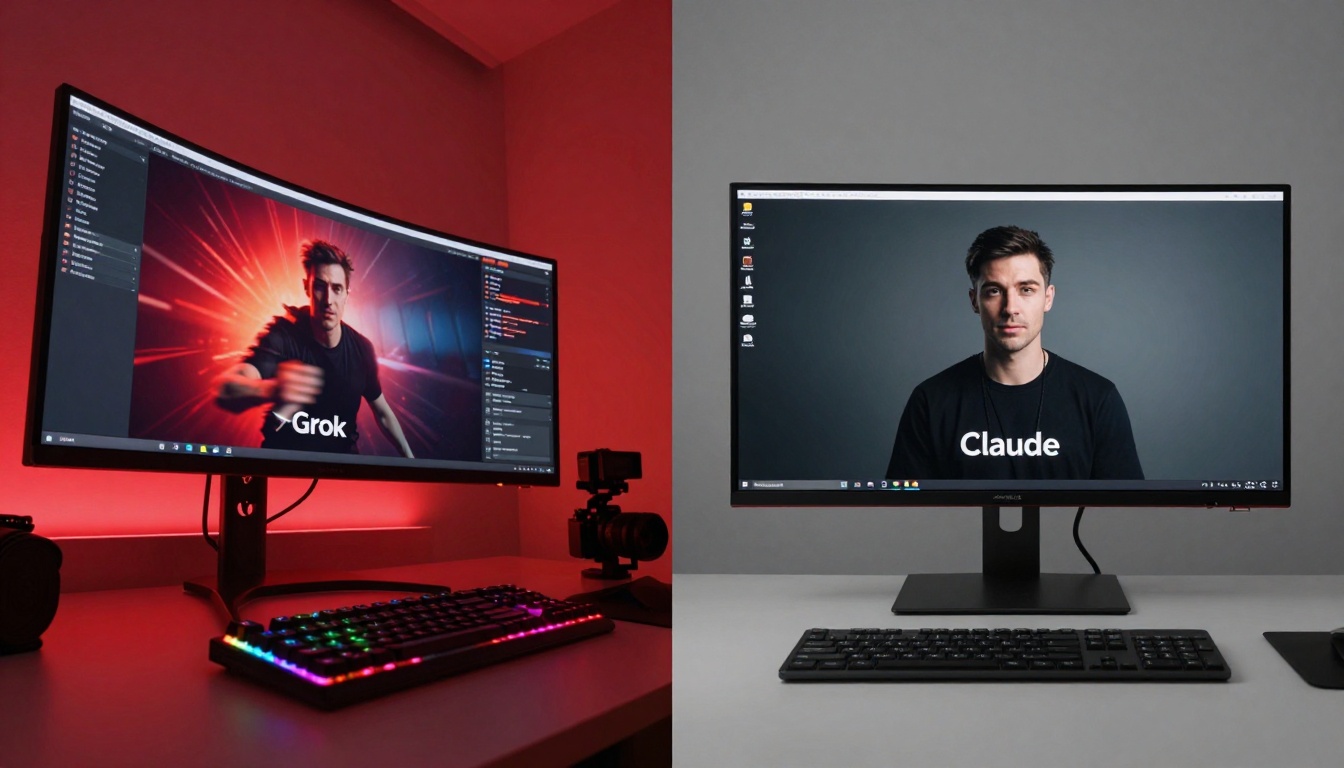
Visual personality contrast: the energetic red of Grok versus the calm blue of Claude
Free access comes through different pathways, each with implications for workflow integration. Grok 4 offers relatively generous free tiers through xAI's platforms, with web and mobile interfaces designed for conversational flow. The integration emphasizes ease of use over advanced features, making it accessible for casual daily interaction.
Claude Opus 4.5 provides free access through Anthropic's platform with more structured interface elements supporting longer-form interaction. The platform includes better tools for document upload, conversation organization, and output formatting—features that support serious work rather than casual chat.
Access considerations for daily users:
- Interface design: Grok's interface prioritizes conversation flow; Claude's interface supports document-heavy workflows
- Mobile experience: Both offer solid mobile apps, but Grok's feels more optimized for quick, on-the-go conversations
- API availability: Free tiers typically don't include API access, limiting automation possibilities
- Export capabilities: Claude provides better options for exporting conversations in organized formats
- Platform stability: Both maintain good uptime, but users report occasional rate limiting during peak hours
Integration with other free AI tools: Both models complement other free AI resources available on platforms like PicassoIA, which offers additional models like GPT-5, Gemini 2.5 Flash, and DeepSeek V3.1. The availability of multiple free models creates opportunities for comparative analysis and specialized tool selection.

Evolution of a conversation: from morning query to evening analysis captured in single frame
Limitations and Considerations
Free access inevitably involves trade-offs. Understanding these limitations helps set realistic expectations and avoid frustration.
Grok 4 limitations to consider:
- Factual accuracy variability: The model's confident style sometimes masks uncertainty about facts
- Depth trade-off for speed: Quick responses may sacrifice comprehensive coverage
- Consistency across sessions: Personality can vary slightly between conversations
- Technical explanation depth: May oversimplify complex concepts
- Formatting capabilities: Less sophisticated document structuring than Claude
Claude Opus 4.5 limitations to consider:
- Response speed: More thorough answers require more processing time
- Creative risk aversion: May avoid unconventional approaches without explicit encouragement
- Conversational spontaneity: Responses can feel overly structured or formal
- Free tier constraints: More restrictive usage limits than Grok's free tier
- Personality expression: Less distinctive voice than Grok's characterful responses
Universal limitations of free AI access:
- Usage caps: Both impose reasonable limits to manage server costs
- Peak time slowdowns: Response times increase during high-demand periods
- Feature restrictions: Advanced features often reserved for paid tiers
- No guaranteed availability: Free access represents goodwill, not contractual obligation
- Evolving policies: Terms and limits can change with platform development
💡 Realistic expectation setting: Free AI access today represents unprecedented capability at zero cost, but it's not equivalent to paid enterprise solutions. The value lies in augmentation rather than replacement of human capability.

The intersection point: where different AI approaches create new possibilities through combination
Choosing Between Them for Specific Tasks
The most effective approach involves matching task characteristics to model strengths rather than seeking a universal winner. Here's a decision framework based on hundreds of comparative tests:
Choose Grok 4 when you need:
- Quick answers without exhaustive detail
- Creative spark and unconventional ideas
- Engaging conversation with personality
- Rapid prototyping of concepts or solutions
- Entertainment value in responses
- Bold suggestions without excessive caution
Choose Claude Opus 4.5 when you need:
- Thorough analysis with multiple perspectives
- Academic rigor and theoretical foundation
- Structured organization of complex information
- Safety-conscious approaches to sensitive topics
- Long-document processing and analysis
- Educational explanations with progressive difficulty
Hybrid approaches that maximize value:
- Sequential workflow: Start with Grok for brainstorming, refine with Claude for structure
- Comparative analysis: Pose same question to both, synthesize insights from both responses
- Specialized delegation: Use Grok for creative tasks, Claude for analytical tasks
- Validation pairing: Generate solution with one model, critique with the other
- Perspective balancing: Get bold perspective from Grok, cautious perspective from Claude
The evolving landscape: As both models continue development, their free offerings will likely expand in capability. Today's comparison represents a snapshot in rapid evolution. What remains constant is the value of having multiple complementary AI perspectives available without financial barrier.
Final perspective: Free access to models of this caliber represents a democratization of advanced AI capability previously available only through substantial investment. Whether through Grok 4's bold engagement or Claude Opus 4.5's refined analysis, users gain powerful cognitive augmentation tools. The practical wisdom lies not in declaring one superior, but in developing fluency with both—understanding when to engage which personality, which approach, which style of thinking.
The true power emerges not from choosing between them, but from developing the discernment to apply each where it shines brightest. This discernment—knowing when to seek Grok's creative spark versus Claude's analytical depth—represents the next level of AI literacy. As these tools continue evolving, that literacy becomes increasingly valuable, transforming how we research, create, and solve problems in an AI-augmented world.
Try experimenting with both models on PicassoIA to develop your own comparative understanding. The platform's free access to multiple leading models creates ideal conditions for developing this AI tool selection fluency—a skill that will only grow in value as these technologies continue their remarkable advancement.


