Something shifted in the last two years, and most people did not notice it happening. AI-generated voices stopped announcing themselves. They stopped sounding like robots reading transcripts and started sounding like people having conversations. Not perfect people, not overly articulate news anchors, but real people with rhythm, hesitation, warmth, and weight behind their words. This article breaks down exactly why that happened, what the technology looks like under the hood, and which models are responsible for the biggest leap forward in voice synthesis history.
Why Old AI Voices Sounded Wrong
For most of the 2000s and 2010s, text-to-speech systems operated on a simple premise: break speech down into phonemes, stitch those phonemes together, and play them back. The problem was the stitching. Human speech is not a series of discrete sound units placed one after another. It flows. Syllables bleed into each other. The tail of one word shapes the beginning of the next.
The Seams That Gave It Away
Early concatenative synthesis systems grabbed small audio clips from a database of recorded speech and glued them together. Listeners could hear the joints. There was a mechanical flatness between words, a robotic evenness in pitch that never varied the way a real person's does when they are excited, tired, or genuinely amused.
Parametric synthesis was slightly more elegant but introduced its own problems. These systems generated speech from mathematical models of the human vocal tract, but the models were too simplified. The output was smooth but hollow, the audio equivalent of a wax figure: recognizable as human in form, but wrong in every subtle way.
What Listeners Actually Detected
Research in psychoacoustics shows that human listeners are extraordinarily sensitive to prosody: the rise and fall of pitch, the timing of pauses, the subtle lengthening of stressed syllables. Early AI voices got the words right but butchered the music of speech. They also lacked co-articulation, the way your tongue and lips begin preparing for the next sound before you have finished producing the current one.
The Architecture That Changed Everything
The transition from robotic to human-sounding AI voices was not a single breakthrough. It was a sequence of architectural shifts, each one removing a layer of artificiality.
WaveNet and the Neural Vocoder Era
In 2016, DeepMind published WaveNet, a deep neural network that generated audio one sample at a time by learning the statistical patterns of real human speech. Instead of gluing together clips or calculating vocal tract parameters, WaveNet learned what speech actually sounds like at the signal level. The quality jump was immediately audible. But the original architecture was too slow for real-time applications.
The years that followed brought faster variants: Parallel WaveNet, WaveRNN, HiFi-GAN. Each one traded some fidelity for speed without losing the core insight: neural vocoders trained on large corpora of real speech sound fundamentally more natural than anything built on older methods.
Transformers and the Attention Breakthrough
The second major shift came with the adoption of transformer architectures for the acoustic modeling component of TTS. Transformers use self-attention mechanisms that allow the model to consider the entire input sequence simultaneously rather than processing it one token at a time.
For speech synthesis, this meant the model could reason about how the word at position 47 should sound based on the emotional trajectory of the sentence it belongs to, not just the immediate neighboring phonemes. The result was a dramatic improvement in long-range prosodic coherence. Sentences started to sound like they belonged together.

What Actually Makes a Voice Feel Human
Understanding the technology is one thing. But what is the model actually trying to reproduce? What specific properties make a voice land as real rather than synthetic?
Prosody: The Music Inside Speech
Prosody refers to the patterns of stress, rhythm, and intonation that carry meaning beyond the words themselves. When a person says "oh, really" with flat intonation it signals polite acknowledgment. When they say it with a rising pitch and a pause before it, it signals genuine surprise. The word "really" has not changed, but the meaning has transformed completely.
Modern TTS models are trained on enormous corpora of emotionally varied speech, often with annotation layers that label prosodic features explicitly. This allows them to model the relationship between meaning, context, and delivery.
Breathing, Pauses, and the Unexpected
Real speakers breathe. They occasionally stumble on a word. They pause before a surprising statement. They clip their vowels when speaking quickly and stretch them when emphasizing. Modern models like ElevenLabs V3 are trained specifically to reproduce these micro-variations because the absence of them is exactly what made older AI voices feel wrong.
💡 The uncanny valley of speech is not about mistakes. It is about the absence of the subtle imperfections that signal authenticity.
Emotion and Intent
The most recent generation of voice models goes further: they attempt to model speaker intent. Not just what the speaker is saying, but why, and with what internal state. Models like Minimax Speech 2.8 HD can output narration that shifts in emotional weight across a long passage, softening for tender moments and tightening for dramatic ones, without being explicitly instructed to do so.

The Models Setting New Standards Right Now
The field has become remarkably competitive. Several models released in the last 12 months have pushed the ceiling of what is possible in neural voice synthesis.
ElevenLabs V3 and V2 Multilingual
ElevenLabs V3 is currently one of the most expressive general-purpose TTS models available. It handles emotional speech with notable accuracy and produces audio that passes as human in most casual listening tests. Its strength is in nuanced delivery: the model does not just read text, it interprets it.
ElevenLabs V2 Multilingual extends that capability across 30+ languages, maintaining accent authenticity and prosodic naturalness even for non-English text. For global content production, it is a significant capability.
ElevenLabs Flash v2.5 trades some expressiveness for speed, making it the practical choice for real-time applications where latency matters more than subtlety.
Minimax Speech 2.8 HD and Turbo
Minimax Speech 2.8 HD targets professional audio production. The output has a depth and warmth that audio engineers describe as sitting well in a mix. It handles long-form narration without the fatigue artifacts that plague some models. Speech 2.8 Turbo runs faster with minimal quality loss, appropriate for high-volume content pipelines.
Gemini 3.1 Flash TTS
Gemini 3.1 Flash TTS brings 30 distinct voices and support for over 70 languages. Its integration with Google's language modeling infrastructure means it has unusually strong contextual awareness. It can parse complex sentence structures and produce delivery that reflects the semantic weight of what is being said.
Qwen3 TTS and Voice Design
Qwen3 TTS introduces a different capability: the ability to clone any voice or design a custom one from scratch. This opens up use cases that go beyond narration into identity and personalization.
How Voice Cloning Actually Works
Voice cloning is where the technology starts feeling genuinely strange. The ability to take a short audio sample of a real person speaking and produce a synthetic version that matches their timbre, accent, and rhythm raises questions as fast as it opens doors.
Reference Audio and Speaker Conditioning
Modern voice cloning works through speaker conditioning: the model takes a reference audio clip, extracts a speaker embedding (a mathematical representation of vocal identity), and uses that embedding to constrain the synthesis process. Everything the model generates is colored by the characteristics of the reference speaker.
Minimax Voice Cloning handles this process with a relatively short reference sample, typically 10 to 30 seconds, and produces output that captures the target voice's fundamental frequency, formant structure, and speaking rhythm.
Resemble AI Chatterbox adds emotion control, allowing you to adjust not just the voice identity but the emotional register of the clone's output, from calm and measured to animated and urgent.
What You Can and Cannot Replicate
Current models can reproduce timbre, pitch range, accent, and rhythm with high fidelity. What they still struggle with is the full set of paralinguistic signals that carry social meaning: the precise quality of a nervous laugh, the specific cadence of sarcasm in a regional accent, the micro-timing variations that encode a speaker's age and health state.
Chatterbox Pro and PlayHT Play Dialog are among the models pushing hardest at these remaining limitations, particularly for conversational and dialogue applications.
Where AI Voices Are Already Running the Show
The deployment of neural TTS is already far broader than most people realize. Many interactions with AI voices go unnoticed precisely because the technology has gotten good enough to not announce itself.

Podcasts, Audiobooks, and Content at Scale
Independent podcasters and audiobook producers are using TTS to produce content at a speed and cost that was not previously accessible. A narrator who previously spent 8 hours recording a 4-hour audiobook can now produce a complete draft in minutes and spend the saved time on editing and production.
Models like ElevenLabs V2 Multilingual make it viable to localize that same audiobook into 10 languages simultaneously, maintaining the original narrator's voice characteristics across all versions.
Customer Support and Enterprise Automation
Contact centers have been early adopters of neural TTS. The shift from clunky IVR systems to voice agents that sound like patient, helpful humans has measurably reduced caller frustration. Turbo v2.5 and TTS 1.5 Max power many of these systems, balancing speed and naturalness for real-time interaction.
Accessibility
For people with visual impairments or reading difficulties, high-quality TTS is not a convenience. It is access to information. The improvement in voice quality has direct implications for dignity: being read to by a voice that sounds present and human is a different experience from being read to by a machine.
How to Make Your Own AI Voice on PicassoIA
PicassoIA gives you direct access to the most capable text-to-speech models available, without API complexity or setup friction. Here is how to get a professional result quickly.
Step by Step with ElevenLabs V3
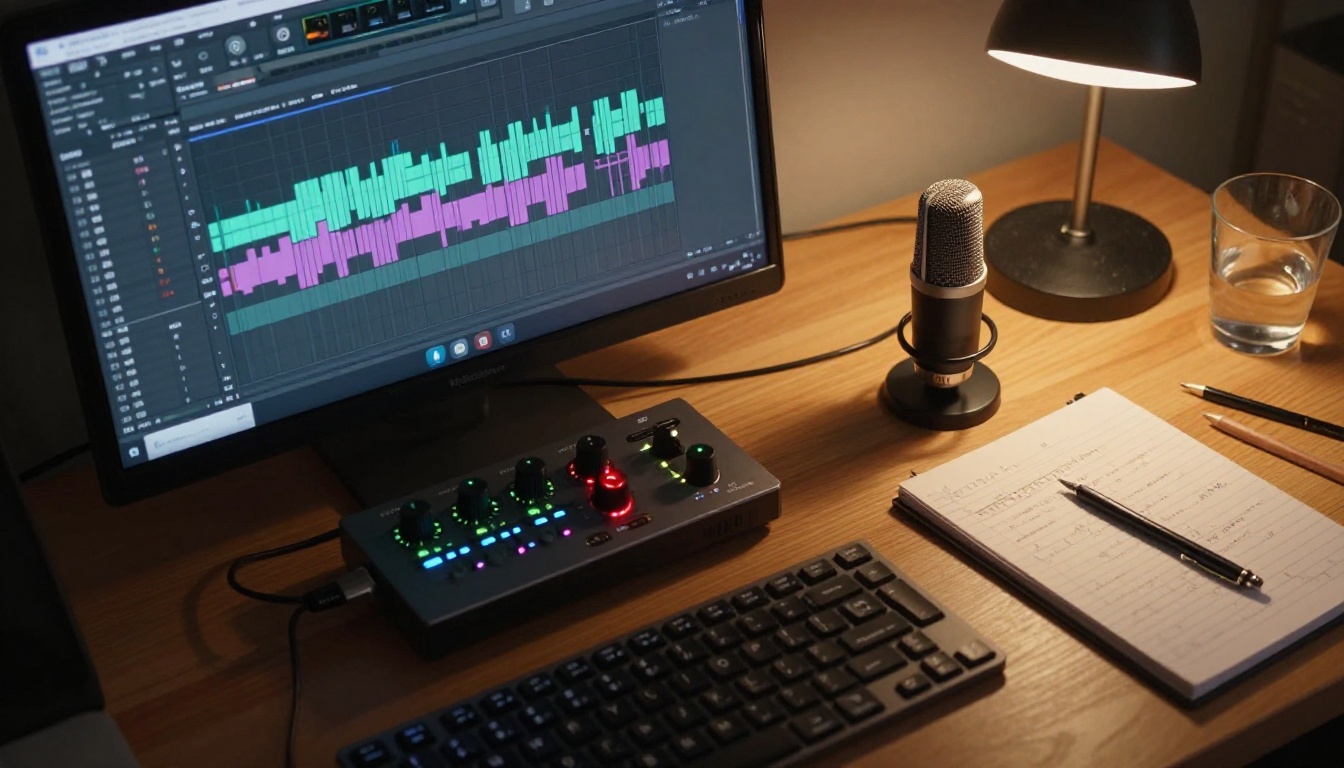
- Go to ElevenLabs V3 on PicassoIA.
- Paste your text into the input field. Write in natural sentences with punctuation, since commas and periods directly influence pacing.
- Select a voice from the available presets, or upload a reference audio clip for voice cloning.
- Set the stability parameter lower for more expressive, varied output. Set it higher for consistent, controlled delivery.
- Set the similarity boost high if you want the output to closely match a cloned voice.
- Generate and listen. Download the output as WAV or MP3.
Tips for the Best Results
- Punctuation shapes delivery. An ellipsis creates a longer pause than a comma. A question mark changes the terminal pitch of a sentence. Use them deliberately.
- Shorter segments sound more natural. Breaking long paragraphs into shorter sentences before feeding them to the model typically produces better prosodic flow.
- Emotional context in the text matters. Models like ElevenLabs V3 respond to the semantic content of what is written. Writing dialogue that contains emotion will produce more emotionally appropriate delivery without additional configuration.
- For multilingual output, Gemini 3.1 Flash TTS performs better when the text is in the target language natively rather than translated mid-prompt.
💡 The best TTS output comes from thinking like a voice director, not a typist. The way you write the text is as important as the model you choose to read it.
What's Still Not Perfect
It would be dishonest to suggest that neural TTS has solved everything. There are still edges where the technology reveals itself.

The Edge Cases That Still Trip Models Up
Long, highly technical passages with unusual proper nouns or abbreviations still produce inconsistent pronunciation across models. Humor is notoriously hard to deliver convincingly because comedic timing requires extremely precise micro-timing that most models do not yet fully control. Sarcasm, which in human speech is signaled by a very specific combination of prosodic features, remains a genuine challenge.
PlayHT Play Dialog is explicitly designed for conversational content and handles multi-turn dialogue better than models optimized for narration, but even it occasionally flattens the emotional curve at the end of long exchanges.
The other persistent issue is consistency across long documents. A model generating a 30-minute audio file may drift slightly in its treatment of the voice between the beginning and end. Minimax Speech 2.8 HD handles this better than most, but it remains a known limitation of the architecture.
Why This Still Matters
Despite these limitations, the gap between "clearly synthetic" and "possibly human" has narrowed so dramatically that the exceptions now define the state of the art rather than the baseline. A year ago, naturalness was the accomplishment. Today, the conversation is about emotional precision and stylistic control.
Try It Yourself
The gap between reading about neural TTS and actually hearing it is significant. No description of prosodic modeling or attention mechanisms conveys what it sounds like when a model reads a sad passage and the voice actually sounds a little sad.

PicassoIA gives you instant access to the full range of models discussed in this article. You can run ElevenLabs V3 against Minimax Speech 2.8 HD on the same paragraph and hear the difference directly. You can clone a voice with Qwen3 TTS, test Gemini 3.1 Flash TTS across multiple languages, or build a full narrated audio piece with Chatterbox Pro.
The technology has crossed a meaningful threshold. What comes next depends on what people actually do with it.
Start with a piece of text you care about. Use a voice that fits the tone. Listen to the result. That is the only way to know where the technology actually is right now.


