This article breaks down Kimi K2 Thinking into its core components, showing how this cognitive architecture enables AI systems to reason through complex problems with multi-step analysis, hypothesis testing, and structured decision-making. We explore the technical implementation, real-world applications, and what sets this approach apart from conventional language model responses.
When you ask a standard AI system a complex question, you typically get a direct answer—but when you engage with a system using Kimi K2 Thinking, you get something fundamentally different: a transparent reasoning process that shows how the answer was reached. This isn't just about getting results; it's about understanding the cognitive journey that leads to those results.
What Kimi K2 Thinking Actually Means
Kimi K2 Thinking refers to a specific cognitive architecture implemented in AI systems that enables structured, multi-step reasoning. Unlike standard language models that generate responses based on statistical patterns, systems using this approach actually think through problems step by step.
💡 The Core Difference: Standard AI gives you answers; Kimi K2 Thinking shows you the reasoning behind those answers. It's the difference between being told "the answer is 42" and being shown the mathematical proof that leads to 42.
This thinking process mirrors how human experts approach complex problems: they don't jump to conclusions but instead follow a logical path of analysis, hypothesis testing, and validation. The "K2" designation specifically refers to the second-generation implementation that significantly improved upon earlier reasoning approaches.
How It Differs From Standard AI Responses
Let's look at a concrete example. When asked "Should a company invest in renewable energy?", here's how different approaches respond:
Standard Language Model Response:Direct answer with supporting points
"Yes, companies should invest in renewable energy because..."
Lists environmental benefits
Mentions cost savings over time
References regulatory trends
Kimi K2 Thinking Response:Structured reasoning process
Problem Analysis: "First, we need to understand what factors determine this investment decision."
Recommendation Synthesis: "Given analysis above, recommendation with highest probability of positive outcome is..."
The critical distinction is visibility into the thinking process. You're not just getting an answer—you're getting the methodology that produced the answer. This transparency builds trust and allows for course correction if the reasoning contains flaws.
The Cognitive Architecture Behind the Scenes
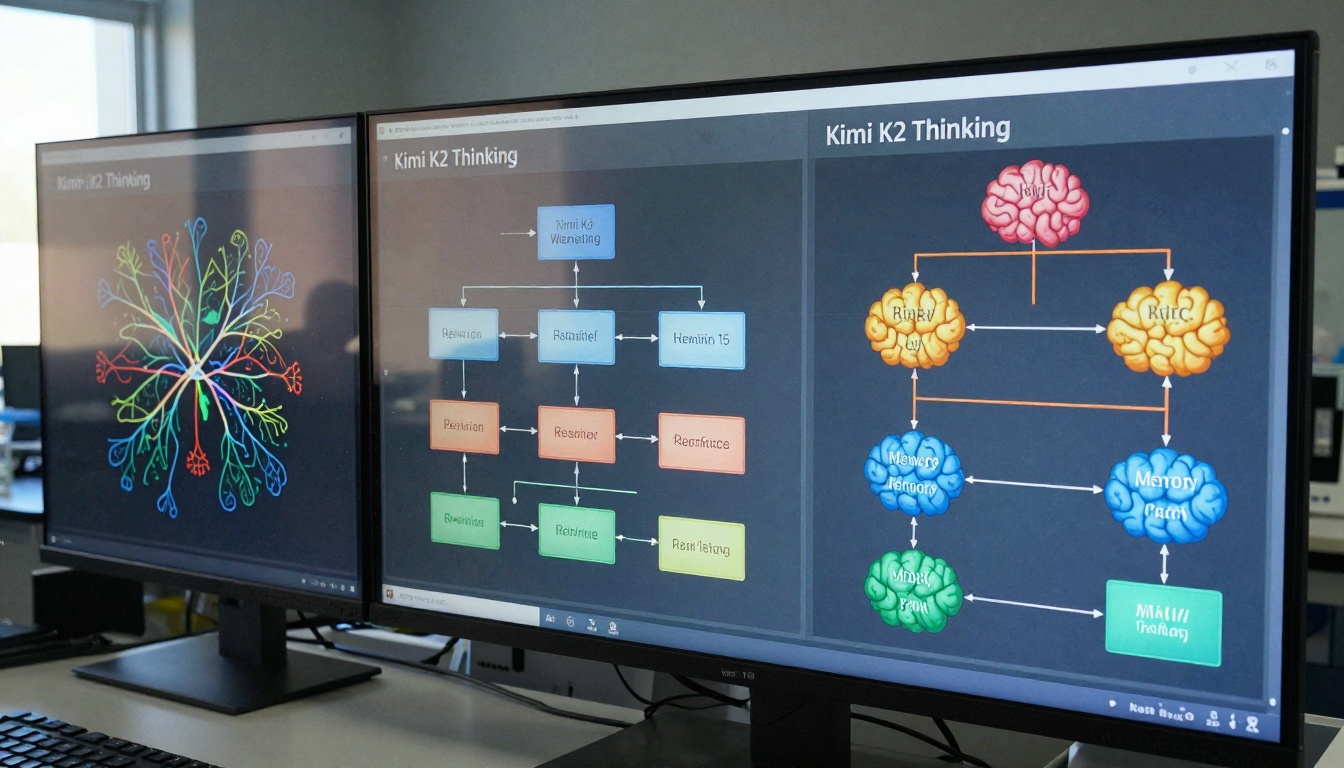
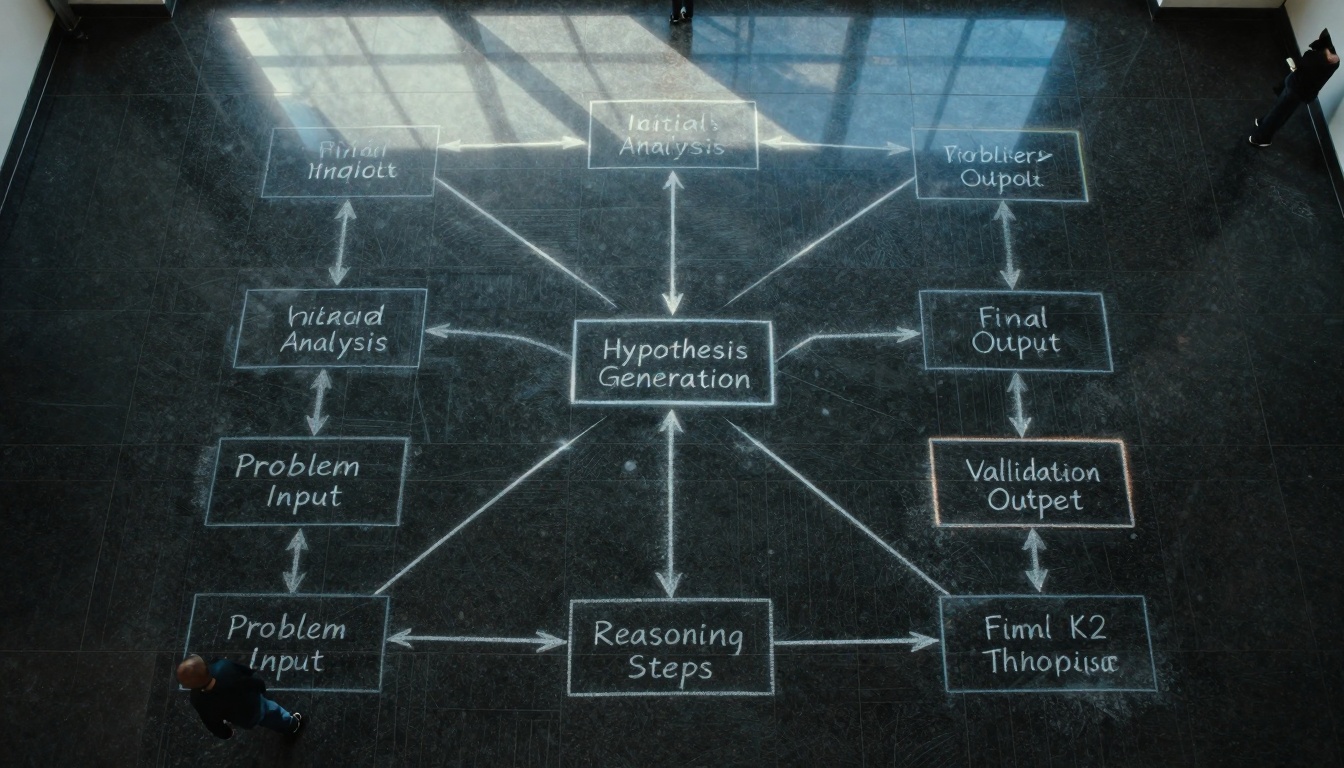
Kimi K2 Thinking operates through a layered architecture that processes information in stages:
Generates multiple possible approaches to the problem
Creates alternative solution pathways
Establishes evaluation criteria for each approach
Maps dependencies and relationships between elements
Layer 4: Step-by-Step Reasoning Execution
Executes the chosen reasoning pathway
Documents each step of the cognitive process
Validates intermediate conclusions
Adjusts approach based on intermediate results
Layer 5: Validation & Cross-Checking
Tests final conclusions against multiple criteria
Identifies potential biases or flawed assumptions
Compares results with alternative approaches
Confirms logical consistency throughout the chain
Layer 6: Synthesis & Output Generation
Formulates the final answer or recommendation
Presents the reasoning process transparently
Highlights key decision points and turning points
Provides confidence levels and uncertainty estimates
This architecture ensures that reasoning isn't a black box but a traceable process where each cognitive step can be examined, validated, and if necessary, corrected.
Step-by-Step Reasoning Process in Action
Let's walk through exactly what happens when Kimi K2 Thinking tackles a complex problem:
Phase 1: Problem Decomposition
The system doesn't see a monolithic question but breaks it into component parts. For example, "How should we price our new software product?" becomes:
Market analysis of competitors
Cost structure calculation
Value proposition assessment
Customer willingness-to-pay estimation
Strategic positioning considerations
Each component gets its own dedicated analysis thread.
Phase 2: Parallel Processing
Multiple reasoning threads run simultaneously:
Thread A: Analyzing competitor pricing models
Thread B: Calculating development and maintenance costs
External verification (do conclusions match reality?)
Peer review simulation (would experts agree?)
Historical accuracy testing (did similar reasoning work before?)
Validation requires its own multi-layer approach.
Explainability vs. Efficiency Trade-off
The very transparency that makes Kimi K2 valuable also creates efficiency trade-offs:
Documenting every step adds overhead
Maintaining state for auditability consumes resources
Presenting reasoning process requires additional formatting
Allowing user interruption mid-reasoning adds complexity
There's a constant balance between thoroughness and practicality.
Future Development Directions
Several promising directions are emerging for Kimi K2 Thinking systems:
Hybrid Reasoning Approaches
Combining Kimi K2 with other AI techniques:
K2 + Reinforcement Learning: Systems that learn optimal reasoning strategies through trial and error
K2 + Evolutionary Algorithms: Reasoning pathways that evolve toward more efficient patterns
K2 + Bayesian Networks: Probabilistic reasoning with uncertainty quantification
K2 + Causal Inference: Understanding cause-effect relationships in reasoning chains
These hybrids aim to overcome individual limitations through combination.
Distributed Reasoning Networks
Moving beyond single-system thinking:
Multi-system collaboration: Different K2 instances specializing in different domains
Human-AI co-reasoning: Seamless integration of human insight with AI analysis
Cross-validation networks: Multiple reasoning pathways that validate each other
Incremental knowledge sharing: Systems that learn from each other's reasoning experiences
This approaches collective intelligence at scale.
Adaptive Reasoning Frameworks
Systems that adjust their reasoning approach based on context:
Problem-type recognition: Different strategies for analytical vs. creative problems
Resource-aware reasoning: Adjusting thoroughness based on available compute/time
Confidence-based pruning: Focusing resources on uncertain aspects
Interactive refinement: Real-time adjustment based on user feedback
The goal is reasoning that's both robust and efficient.
Integration with PicassoIA Models
The kimi-k2-instruct model on PicassoIA represents one implementation of this reasoning architecture. When using this model through the platform, you're accessing a system specifically designed for structured, transparent reasoning processes.
This differs significantly from using standard image generation models like flux-2-pro or language models like gpt-4o, which focus on direct output generation rather than reasoning process documentation.
Why This Approach Matters for AI Development
Kimi K2 Thinking represents more than just another AI technique—it addresses fundamental concerns about AI trust, reliability, and usefulness:
Building Trust Through Transparency
When users can see the reasoning process, they develop confidence in the system:
They understand why recommendations were made
They can identify potential flaws in the reasoning
They learn alongside the AI system
They become active participants rather than passive recipients
This transparency transforms AI from oracle to collaborator.
Enabling Human Oversight and Correction
The documented reasoning chain allows for meaningful human oversight:
Experts can intervene at specific reasoning steps
Flawed assumptions can be corrected mid-process
Alternative perspectives can be incorporated
The system learns from human feedback at granular level
This creates a true partnership between human and artificial intelligence.
Creating Auditable Decision Trails
In regulated industries or high-stakes applications:
Decision justification becomes part of the record
Regulatory compliance is demonstrable
Accountability can be traced to specific reasoning steps
Continuous improvement based on decision outcomes is possible
The reasoning documentation serves as both process record and learning resource.
Advancing AI Capabilities Through Self-Reflection
Systems that document their own thinking enable meta-cognitive analysis:
Which reasoning strategies work best for which problems?
Where do reasoning chains typically break down?
How can reasoning efficiency be improved?
What knowledge gaps most frequently cause problems?
This self-analysis drives continuous improvement of the reasoning system itself.
The emergence of Kimi K2 Thinking marks a significant shift in how we approach artificial intelligence. It's not just about building systems that can answer questions, but building systems that can show their work—that can reason through problems in ways that are transparent, auditable, and collaborative.
As this technology evolves, we're likely to see it integrated across more domains, from healthcare and finance to education and creative work. The key insight isn't just that AI can think, but that we can build AI systems whose thinking processes we can understand, validate, and improve alongside them.
If you're interested in experiencing this reasoning approach firsthand, try working with the kimi-k2-instruct model on PicassoIA. Pay attention not just to the answers you get, but to the reasoning process that produces those answers. Notice how the step-by-step analysis differs from standard AI responses, and consider how this transparency could be valuable in your own work with AI systems.