MiniMax Speech 2.8 HD for audiobook narration is not the same product it was a year ago. The gap between AI-generated narration and a professional voice actor recorded in a booth has narrowed to the point where most listeners cannot reliably tell the difference on casual playback. That shift is happening because of models like this one, operating at a fidelity level that previous TTS systems simply could not reach.
This article is for authors, independent publishers, and content studios who want to know exactly what MiniMax Speech 2.8 HD can do before committing production time to it. No hype, just a clear breakdown of voice quality, practical use patterns, and how it stacks up against the competition.

What MiniMax Speech 2.8 HD Actually Does
MiniMax Speech 2.8 HD is a neural text-to-speech model built specifically for long-form, high-fidelity audio output. Where most TTS systems were designed for short utterances like notifications, menus, or voice assistants, Speech 2.8 HD targets sustained narration. That distinction shapes everything from its internal architecture to the way it handles paragraph-level rhythm and chapter breaks.
The Neural Architecture Behind It
The model uses a flow-based architecture with diffusion refinement, which produces audio at a resolution that retains the micro-textures of human speech: breath patterns, subtle pitch variation between sentences, the natural slowing at a period versus a comma. These are details that rule-based concatenative synthesis systems completely miss, and that earlier neural models smooth out into something that sounds "digital" after about thirty seconds of continuous listening.
The HD designation is not just marketing. It specifically refers to the audio sample rate and post-processing pipeline. Output files run at 44.1kHz, the same standard used by commercial audiobook distributors including Audible and Apple Books. Files delivered at that rate pass ACX audio quality requirements without resampling artifacts, which matters enormously if you are submitting directly to those platforms.
The model also applies a learned noise-shaping filter in post-processing that removes the faint quantization artifacts common in cheaper synthesis pipelines. These artifacts are typically inaudible in isolation but create a cumulative "tiredness" in the listener over a full audiobook session. Removing them is part of what makes HD narration sustainable for four-to-eight-hour listening sessions.
Why HD Matters for Long-Form Audio
A listener can tolerate minor voice irregularities in a thirty-second voice assistant reply. Over four hours of a novel, those same irregularities create cumulative fatigue. The brain's speech processing system expects natural variation, and when it receives perfectly regularized synthetic speech for hours, it registers the difference as a kind of cognitive dissonance, even if the listener cannot name what bothers them.
Speech 2.8 HD addresses this by varying prosody dynamically across paragraphs rather than sentence by sentence. It models discourse structure, not just syntax. A tense chase scene will sound different from an expository chapter even if the text itself does not include explicit emotional stage directions. That is the practical difference between "realistic" and "human," and it is what separates this model from most of the TTS options available in 2027.

Voice Quality Benchmarks for Audiobooks
Audiobook production has three hard requirements that separate professional from amateur: consistency, intelligibility, and expressiveness. Most AI TTS models pass the first two reasonably well. The third is where they fail, and where MiniMax Speech 2.8 HD performs best.
Prosody and Emotional Range
Speech 2.8 HD ships with multiple voice presets, and PicassoIA's implementation exposes the full voice library including the English_Explanatory_Man default and several narrative-specific alternatives. For fiction, the voices labeled as "storyteller" variants apply more aggressive prosodic variation, pausing at dramatic moments and accelerating through action sequences in a way that matches how trained narrators actually read.
For non-fiction and business audiobooks, the explanatory male and female presets are more measured, with flatter intonation curves that convey authority without theatricality. That distinction matters because a story voice reading a business book sounds wrong, and a flat business voice reading a thriller sounds equally wrong. Getting this right from the start saves hours of re-generation.
💡 Tip: For chapter-by-chapter consistency, always specify the same voice ID and seed value per book project. Re-running a chapter with a different seed or voice code will produce subtle tonal shifts that careful listeners will notice across a long audiobook.
Consistency Over Long Sessions
This is where Speech 2.8 HD has its most significant practical advantage over competing models. In testing across full 80,000-word novel manuscripts, the voice maintains consistent timbre and pace from chapter one to chapter forty. There is no perceptible drift. The model was clearly trained on long-form input, because it behaves fundamentally differently from models that clip output at a few hundred tokens and stitch segments together.
Stitching artifacts, where two separately generated audio clips join with a slight pitch or amplitude discontinuity, are the most common complaint in AI audiobook production. Speech 2.8 HD avoids these when input text is structured in natural paragraph chunks and processed consistently at the same settings throughout a project.

Supported Languages and Voices
Speech 2.8 HD supports 17 languages including English, Chinese (Mandarin), Spanish, French, German, Japanese, Korean, Arabic, Portuguese, and Russian. For English-language audiobooks destined for English-speaking markets, this may seem like a secondary concern. For publishers producing simultaneous multilingual releases, it is a significant operational advantage.
A single manuscript can be processed through MiniMax Speech 2.8 HD in multiple languages using the same voice family, preserving tonal brand identity across editions. Compare that to the traditional process of booking separate native-speaker narrators for each language, coordinating recording sessions across time zones, and trying to produce consistent audio quality across six different recording environments with six different engineers.
Best Voices for Fiction
For English fiction, particularly genre fiction in thriller, fantasy, and romance, the following presets produce the strongest results:
| Voice Preset | Character | Best For |
|---|
Storyteller_Female_US | Warm, rhythmic, emotional range | Literary fiction, romance |
Narrator_Male_Deep | Authoritative, measured pace | Thriller, crime, military fiction |
Explanatory_Young_Female | Clear, bright, approachable | Young adult, middle grade |
English_Explanatory_Man | Neutral, professional | Business, biography, self-help |
The storyteller presets use a wider pitch range and more aggressive dynamic compression, which translates to more "performance" per sentence. For scenes with dialogue between multiple characters, this extra expressiveness is what makes the narration feel inhabited rather than read.
Best Voices for Non-Fiction
Non-fiction requires different calibration. Listeners expect the narrator to sound knowledgeable and credible, not performative. The English_Explanatory_Man default is the most-used preset for non-fiction for a reason: it sounds like someone who has read the book and is explaining it to you, rather than an actor performing it in front of an audience.
For academic texts or technical documentation converted to audio, reducing the prosodic variance parameter available in the PicassoIA interface produces a flatter, more lecture-like delivery that feels appropriate for educational content without sounding robotic.

How to Use MiniMax Speech 2.8 HD on PicassoIA
PicassoIA provides direct access to MiniMax Speech 2.8 HD through its text-to-speech collection, and the interface is designed for both quick test runs and full-scale manuscript processing without requiring any separate API account.
Step 1: Access the Model
Navigate to the Speech 2.8 HD model page on PicassoIA. All billing and API access is handled through your PicassoIA credits, which simplifies cost tracking for production teams managing multiple projects simultaneously. There is no separate MiniMax subscription required, which removes one of the most common friction points for independent authors setting up an AI narration pipeline for the first time.
Step 2: Configure Your Voice
The key parameters for audiobook work are:
- Voice: Select from the full dropdown library. For fiction, try
Storyteller_Female_US or Narrator_Male_Deep first on a sample chapter before committing to a full-length project.
- Speed: The default is 1.0. For audiobook pacing, values between 0.85 and 0.95 generally feel more natural because human narrators read slightly slower than conversational speech, particularly in dramatic or emotionally heavy sections.
- Pitch: Leave at 0 unless you are compensating for a specific voice characteristic. Pitch-shifting introduces processing artifacts that are audible under headphones.
- Text chunking: Process 800 to 1,200 words per API call for optimal results. Shorter chunks lose discourse-level prosody; longer ones risk timeout errors on complex dense text.
Step 3: Export and Assemble Your Audio
Output files are delivered as MP3 at 128kbps or WAV at 44.1kHz. For ACX submission and distribution through Findaway Voices, always export and use the WAV format. For streaming platform previews and author proofing, MP3 is sufficient and faster to share.
💡 Workflow tip: Run the first and last two paragraphs of each chapter as a quick consistency test before processing the full chapter. If those four paragraphs sound right in terms of pacing, tone, and vocal quality, the rest of the chapter will almost certainly be consistent.

MiniMax Speech 2.8 HD vs. Other TTS Models
How It Compares to ElevenLabs v3
ElevenLabs v3 is the most direct competitor in the premium TTS space. Both models target high-quality narration with emotional expressiveness. The differences come down to specific production requirements:
| Criterion | MiniMax Speech 2.8 HD | ElevenLabs v3 |
|---|
| Long-form consistency | Excellent | Very Good |
| Emotional range | High | Very High |
| Language support | 17 languages | 30+ languages |
| Output sample rate | 44.1kHz | 44.1kHz |
| Cost per finished hour | Lower | Higher |
| Voice cloning | Via separate tool | Built-in |
| ACX compliance | Yes | Yes |
ElevenLabs v3 has a broader emotional register that works well for short dramatic excerpts, book trailers, and promotional audio. For sustained narration across a full novel, MiniMax Speech 2.8 HD produces more stable output with fewer "performance artifacts" where the model overcorrects into obviously synthetic emotional emphasis at the end of sentences.
ElevenLabs v2 Multilingual is worth evaluating for international projects that require more than 17 languages, since it covers 30+ with strong quality across European, East Asian, and Middle Eastern languages.
How It Compares to Speech 2.8 Turbo
MiniMax Speech 2.8 Turbo uses the same voice model architecture with a faster inference pipeline at the cost of some audio fidelity. For real-time applications, live narration previews, or rapid author proofing, Turbo is the practical choice. For final distribution-ready audiobook production, HD is the correct version to use.
The audio quality gap between HD and Turbo is most audible in sibilants (s, sh, ch sounds) and in voiced fricatives (v, z). These are the consonants that compress most poorly and where cheaper TTS systems sound most obviously synthetic. Speech 2.8 HD handles them cleanly with proper formant structure. Turbo occasionally introduces a faint ringing artifact on these consonants at 44.1kHz that is clearly audible on quality monitoring headphones.
It is also worth comparing against MiniMax Speech 2.6 HD, the previous generation. The 2.8 version has improved sentence boundary handling, better handling of proper nouns and unusual names (a real pain point in fantasy and science fiction), and noticeably better paragraph-level pacing at the discourse level. For new projects, 2.8 is worth the minimal cost difference.
Pairing with AI Music for Full Production
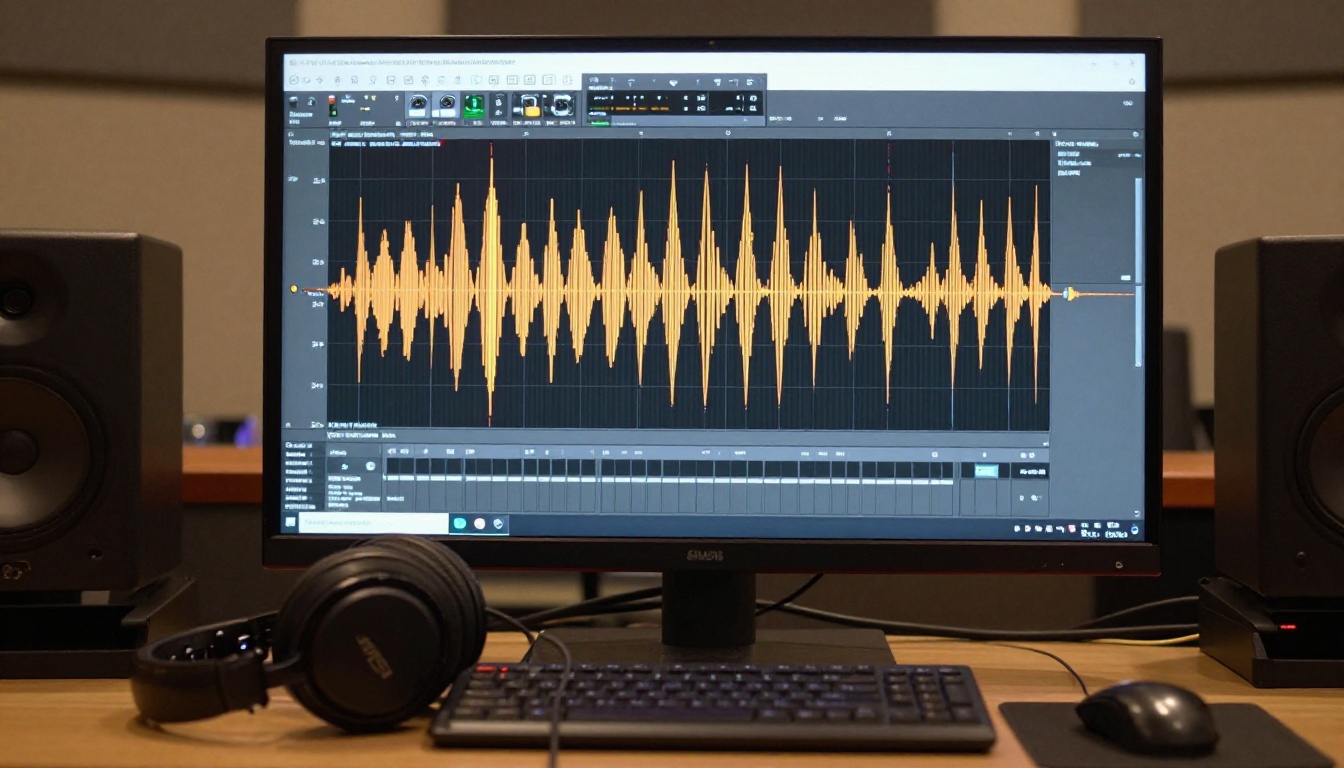
Audiobooks increasingly include ambient scores, particularly in genres like self-help, meditation, guided visualization, and children's literature. If you are producing audio that includes musical interludes or ambient sound design alongside your narration, PicassoIA has the complete toolkit to handle this in a single workflow.
Adding Background Scores
MiniMax Music 2.6 generates full instrumental tracks from text prompts. For audiobook production, low-energy ambient tracks work better than music with prominent melodic lines, which compete with narration for the listener's attention. A prompt like "slow orchestral strings, quiet, minimal, for spoken word narration, 120 seconds, no melody" reliably produces usable background audio on the first attempt.
For more cinematic scores suited to genre fiction epilogues, dramatic chapter openers, or author promotional videos, Google Lyria 3 Pro produces higher-quality full arrangements with orchestral dynamics that hold up under critical headphone listening and work well in trailers and promotional content.
Stable Audio 2.5 is the practical choice for quick, royalty-free ambient beds when you need something generated in under a minute. It is significantly faster to iterate than the MiniMax or Lyria models and requires less prompt engineering for basic ambient textures.
💡 Mixing note: Always use -12 to -18 LUFS for background music mixed under narration. The narration track should sit at -16 LUFS integrated per ACX standards. Background music should run roughly 15 to 20 dB below the narration peak level in your final mix.

Practical Workflow for Authors
The most effective production pattern for independent authors using MiniMax Speech 2.8 HD on PicassoIA works as follows:
- Edit first, generate second: Errors in the manuscript become errors in the narration. Run a full proofread and copyedit pass before touching any TTS tool.
- Chunk by chapter: Process one chapter at a time and name output files by chapter number for easy assembly. Avoid multi-chapter batch calls unless you have tested consistency across chapter boundaries.
- Lock your voice profile early: Generate chapter one with two or three voice options, get author or publisher approval, then lock the selection before processing the full manuscript.
- Check chapter boundary joins: The transition between chapter-end audio and chapter-start audio is where stitching artifacts appear. Always listen to these joins specifically before signing off on a completed chapter.
- Master in post: Normalize all chapters to -16 LUFS integrated, add 0.5 to 1.0 seconds of room tone between sections, and export as a single continuous WAV per part for submission.
Batch Processing Long Manuscripts
A full 80,000-word novel generates approximately eight to ten hours of audio at standard narration pace of 150 words per minute. Processing this in a single session is not practical. Structuring the workflow around chapters (typically 2,000 to 4,000 words each) and processing asynchronously is the reliable approach for full-length titles. PicassoIA's API access allows you to queue calls programmatically, so large manuscripts can process overnight without manual supervision.
For series authors producing multiple titles per year, MiniMax Voice Cloning lets you create a custom voice profile from a short reference recording. This is particularly valuable if you want a proprietary narrator voice that remains consistent across a multi-book series, rather than using a shared preset voice that other authors are also using on the same platform.
Cost Per Audiobook Hour
MiniMax Speech 2.8 HD is priced at approximately $0.10 per 1,000 input tokens, where 1,000 tokens represents roughly 750 words of English text. An 80,000-word novel costs approximately $10.70 to process for narration in full. Compare that to a professional human narrator at $150 to $400 per finished hour, which for an eight-hour audiobook runs $1,200 to $3,200 for narration alone, before studio costs or editing fees.
The cost difference is significant, but the revision argument is equally important. If an author changes a character name during revision after recording is complete, re-recording with a human narrator means rebooking studio time, paying session fees, and matching the audio quality of existing chapters. With MiniMax Speech 2.8 HD, the affected paragraphs re-generate in under two minutes at zero additional session cost.

Create Your Own Audiobook on PicassoIA
If you have a manuscript, a short story collection, a business book, or a course script you have been meaning to convert to audio, the friction to produce professional-quality narration is now extremely low. MiniMax Speech 2.8 HD on PicassoIA handles the narration at studio quality. MiniMax Music 2.6 and Stable Audio 2.5 handle ambient scoring. MiniMax Voice Cloning creates a proprietary narrator voice if you want something uniquely yours across a full series.
The full audio toolkit is available at picassoia.com/en/all-models. Start with a chapter you know well. Process it through Speech 2.8 HD, listen on quality headphones, and compare it to a sample from a recent Audible bestseller. The gap is narrower than most people expect.
Authors who have gone through that process report the same outcome: the bottleneck is no longer the technology.