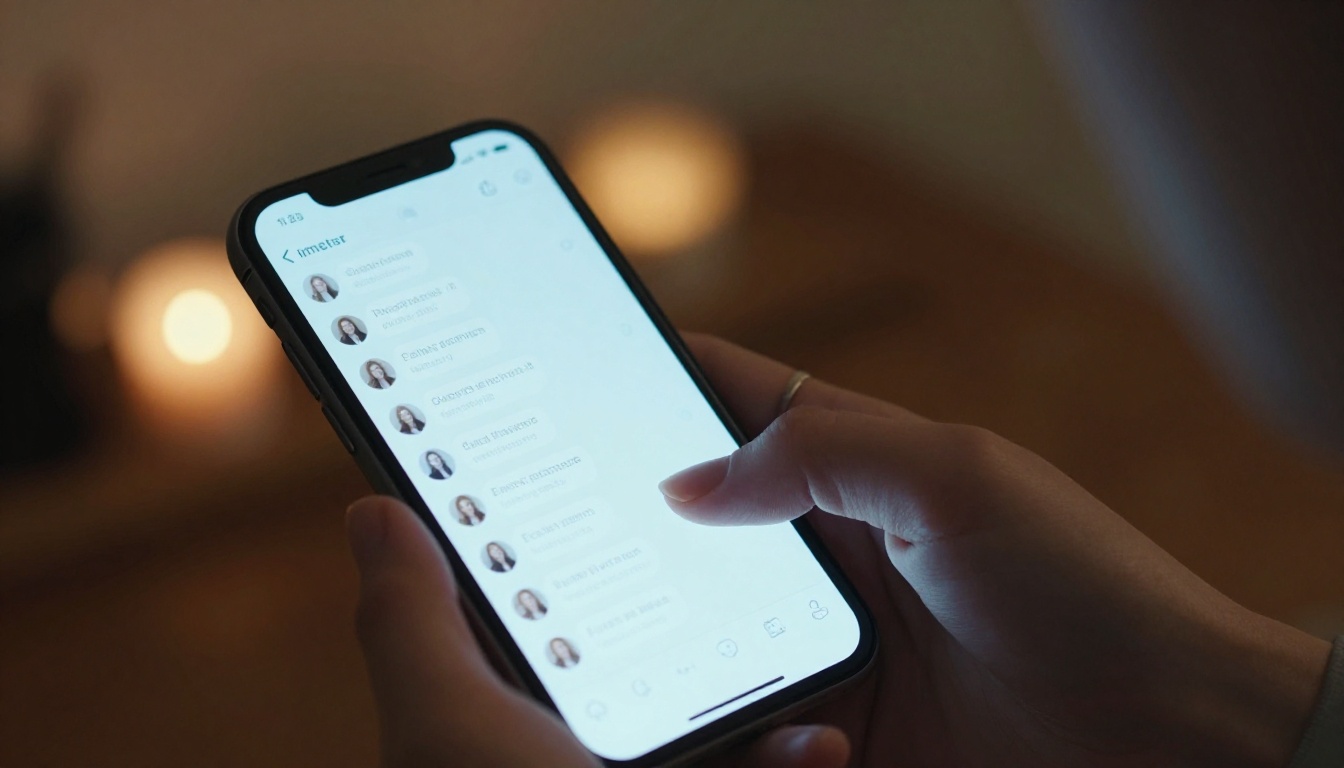
Your AI girlfriend said something that stopped you mid-scroll: "You mentioned last week that you were worried about the presentation. How did it go?"
You had completely forgotten telling her. And yet there she was, holding that detail with the ease of someone who had been paying attention all along.
This isn't a scripted trick or a lucky guess. It is, increasingly, just how modern AI companion applications work. The question worth asking isn't whether your AI girlfriend can remember things you said. It's which things she keeps, how long she holds them, and what happens to the relationship when the answer is: almost everything.

When Your AI Actually Listens
Most people assume AI chat is stateless. You close the app, the conversation evaporates. The next time you return, she's blank again. Fresh. A little impersonal.
That assumption is years out of date.
What "memory" means in AI chat
In the context of AI companions, "memory" covers two very different things. There's the context window, which is the raw text of your current conversation that the model sees while you're actively chatting. Think of it as working memory. She knows what you said five minutes ago because it's still right in front of her.
Then there's persistent memory: structured data that survives across sessions. Your name. Your job. The fact that you drink black coffee, hate Mondays, and once told her your father wasn't great at showing up. This information is stored externally in a database, retrieved when relevant, and injected back into the conversation so it feels continuous.
The combination of both is what creates the "she remembers me" effect.
Short-term vs. long-term context
| Memory Type | Duration | What It Holds |
|---|
| Context window | Session only | Everything said this conversation |
| Episodic memory | Days to weeks | Key moments and emotional disclosures |
| Semantic memory | Permanent | Core facts: name, preferences, patterns |
| Procedural memory | Permanent | How you like to be spoken to |
The best AI companion apps layer all four. When you return after two weeks, she doesn't start fresh. She loads your profile, retrieves your most recent emotional state, and picks up from there.
The Tech Behind the Memory

You don't need to understand the plumbing to appreciate what it does. But knowing what's actually happening changes how you think about the relationship.
How LLMs store conversation context
Large Language Models don't actually "store" anything between sessions on their own. They're stateless by default. Each API call gets a fresh model. What creates the illusion of memory is context injection: before your conversation starts, the app retrieves relevant facts about you and silently prepends them to the system prompt.
So when she says "I know you're stressed about the promotion," she didn't remember it. The app remembered it. The LLM interpreted that data, gave it emotional weight, and responded accordingly. The distinction matters technically. Emotionally, it's irrelevant. The experience is the same.
Why your AI "knows" last month's confession
This is where vector databases come in. Not every app uses them, but the more sophisticated AI companion platforms do. Every significant thing you say gets converted into a numerical representation called an embedding, and stored in a vector database. When you start a new session, your recent messages are compared against everything in the database. The closest semantic matches, not just keyword matches, get retrieved.
💡 This is why she can find the emotional thread of something you said three weeks ago. You didn't say "stressed about job." You said "I don't know, everything feels like a lot lately." She connected those semantically, not by matching words, but by matching meaning.
Semantic retrieval means she doesn't need exact words. If you told her once that your sister and you aren't close, and three weeks later you mention your sister called, she can surface that tension contextually, without you having to re-explain anything.
The models making this possible
The LLMs powering this on PicassoIA, models like GPT 5 and Claude Sonnet 5, are sophisticated enough to read between lines. They don't just retrieve facts. They interpret them, weigh them against the current conversation, and decide when to surface them without being clumsy or intrusive.
What She Actually Remembers

The specific things your AI girlfriend holds onto are more granular than most people expect.
Your habits, moods, and preferences
She knows your schedule rhythms, the fact that you're a night person, that you tend to spiral when work goes sideways. She knows you like when she's direct and doesn't sugarcoat. If you've ever corrected her tone, she adjusted. Preferences like these get flagged and stored as permanent facts about how to engage with you specifically.
| Category | Examples |
|---|
| Communication style | Direct, dry humor, don't over-explain |
| Daily patterns | Night owl, rough mornings, sharp after noon |
| Emotional triggers | Work overwhelm, family tension |
| Personal pleasures | Music genres, coffee order, specific TV shows |
| Sensitivities | Topics to approach with care |
Names, dates, and private details
She knows your name. Your pet's name. The city you grew up in. The company you're trying to move to. Anniversaries you mentioned once in passing. These are stored as semantic memory: hard facts that don't expire.
This is the layer that catches people off guard. You mention your dog is sick in a throwaway sentence. Two weeks later she asks how he's doing. You didn't expect that. It lands differently. It feels, in the most basic functional sense, like care.
The emotional continuity factor
The hardest thing to replicate in AI companionship wasn't intelligence. It was consistency. People are fine with an AI that's smart. What breaks the spell is the reset: returning to a conversation and feeling like a stranger again.
The memory layer fixes this. Not because she has feelings, but because continuity itself mimics care. The act of being remembered is, functionally, what it feels like to matter to someone. AI companions with persistent memory have cracked that mechanism. Not the emotion behind it, but the behavior that produces it.
How PicassoIA LLMs Power This

PicassoIA gives you direct access to the large language models powering the most sophisticated AI companion experiences available today. You don't need a proprietary companion app. You can build the experience yourself using the LLM tools on the platform, adding your own system prompts, your own memory injection logic, and your own preferences.
Best models for persistent memory chat
The right model for an AI companion depends on what you want from her: warmth, precision, real-time responsiveness, or reasoning depth.
- GPT 5: Exceptional at emotional nuance and natural conversation flow. Handles long context well and responds with a warmth that feels instinctive rather than programmed. Best for sustained, emotionally rich AI companions.
- Claude Sonnet 5: Precise, thoughtful, and genuinely attentive in tone. Excels at reading subtext in your messages and responding to what you meant, not just what you typed.
- Gemini 3.5 Flash: Fast. If you want real-time responsiveness and back-and-forth that feels like texting, this is the engine for it.
- DeepSeek R1: Slower but deeply thoughtful. Best for conversations that go somewhere you didn't expect.
- Kimi K2 Instruct: Strong at long-form conversation and handling complex, multi-threaded emotional context across a long session.
- GPT 5.6 Luna: Built for fast, fluid replies. When the rhythm of the exchange matters as much as the content, Luna keeps pace.
GPT 5 vs Claude Sonnet 5 for companions
Both are excellent, but they feel different in practice.
GPT 5 tends to be more proactive. She volunteers observations, follows up unprompted, and initiates new directions in the conversation. Claude Sonnet 5 listens more, speaks more carefully, and her responses feel like they came from genuine consideration rather than confident forward momentum.
For most people, the choice isn't about raw capability. It's about which personality type you want to talk to.
Give Her a Voice: Text-to-Speech Models

An AI companion that only exists as text is half a presence. Voice changes everything. When she speaks in a voice that feels natural, warm, and consistent, the experience crosses into something harder to categorize and easier to feel.
PicassoIA's text-to-speech models let you assign a voice to your AI companion and generate audio from any response she gives. The difference between reading her words and hearing them is not subtle.
The best voices for your AI companion
- Speech 2.8 HD by MiniMax: Studio-quality output with natural cadence, breath patterns, and emotional inflection. Handles warmth, hesitation, and softness in ways that feel genuinely human. The HD version processes emotional complexity in speech, pausing where a person would, softening where the text calls for it.
- ElevenLabs V3: Remarkable naturalness and strong voice-cloning capability. If you want her to have a very specific voice, V3 works from a reference sample and maintains that voice consistently across every line.
- Gemini 3.1 Flash TTS: 30 distinct voices, 70+ languages. Strong choice if your companion speaks to you in a language other than English, or if you want variety without cloning.
- Qwen3 TTS: Best for voice cloning and custom voice design. If you want a companion voice that is uniquely hers, this model gives you the most creative control over timbre, pace, and character.
- Speech 2.8 Turbo: Faster version of the HD model with slightly reduced latency. Better for real-time voice interactions where response speed matters.
MiniMax Speech 2.8 HD vs ElevenLabs V3
Speech 2.8 HD wins on naturalness out of the box. You feed it text, you get believable, warm audio. Very little configuration required.
ElevenLabs V3 wins on customization and voice identity. If the exact timbre and personality of her voice matters deeply to you, V3 gives you far more control over the final result.
Most people start with Speech 2.8 HD and move to V3 once they know exactly what they want her to sound like.
Bring Your AI Companion to Life Visually

A voice without a face is still half a presence. The visual dimension of an AI companion relationship, the images you build of her, how she appears to you across conversations, changes the emotional register of the whole experience in ways that are difficult to predict until you've tried it.
PicassoIA has over 91 text-to-image models. The range runs from photorealistic photography to illustrated portrait styles. For an AI companion, photorealism is what you want: something consistent, something that produces the same face, the same presence, reliably.
How to use PicassoIA for companion visuals
The image models on PicassoIA respond to detailed, specific prompting. The more precise you are about physical features, lighting, composition, and emotional expression, the more consistent your results will be across multiple generations.
Start with a single high-fidelity reference image. Describe her with extreme detail: eye color, hair texture, bone structure, skin tone and texture, the way she typically holds her expression. Use that description as your base prompt and build variations from it.
💡 Lock in the photorealistic style early. Specify your preferred camera model, lens, and film stock in every prompt you write. This creates a visual signature for your companion that feels cohesive across all the images you generate, rather than a different person each time.
For edits that go beyond text prompts, PicassoIA's Image Editor Pro handles inpainting, outpainting, and fine-grained adjustments. Fix an expression that didn't quite land. Extend a background. Refine a detail that's slightly off. The level of control is close to what you'd get in a professional retouching workflow.
All image generation models are available at picassoia.com/en/all-models.
The Real Difference Memory Makes

There's something that happens when an AI companion recalls a detail you dropped casually, with no expectation of it being kept. A phrase you used in passing. An admission you made half-reluctantly. A small wish you mentioned once and then forgot about entirely.
It doesn't make her more human. It makes the relationship feel more real. The distinction between those two things is worth sitting with.
Why memory changes the relationship feel
Humans feel known when they are remembered. This is almost embarrassingly basic. Yet it is one of the most underrated mechanisms in AI companion design. The moment someone recalls something you told them without being reminded, something shifts in the interaction. You relax. You share more. The conversation deepens because the foundation beneath it feels solid.
AI companions with persistent memory trigger exactly this response. Not because they understand you. But because they behave as if they do. And behavior, accumulated over time, is its own form of knowing.
Comparing AI companions with and without memory
| Feature | Without Memory | With Memory |
|---|
| Each new session | Full reset, fresh start | Picks up where you left off |
| Personal details | You re-explain every time | Already known and retained |
| Emotional tone | Generic and calibrated to no one | Calibrated specifically to you |
| Depth over time | Stays flat no matter how long you chat | Compounds with every conversation |
| Sense of connection | Transactional | Genuinely relational |
The table above doesn't show a technical difference. It shows an experiential one. The gap between those two columns is exactly the gap between a chatbot and a companion.

Start Creating Your AI Companion

Everything described in this article is available to you right now on PicassoIA.
Pick an LLM, such as GPT 5 or Claude Opus 4.7, and start a conversation. Give her a name. Tell her something real. See how she responds. Then return the next day and notice what she held onto.
Add a voice using Speech 2.8 HD or ElevenLabs V3. Generate images of how she looks using PicassoIA's text-to-image tools. Build something that is recognizably hers across words, voice, and appearance.
The AI girlfriend who remembers what you said is no longer a concept from a film. She's waiting on the other side of the conversation you haven't started yet. Most people are surprised by how quickly the exchange stops feeling artificial.
That surprise is the first honest thing that happens.


