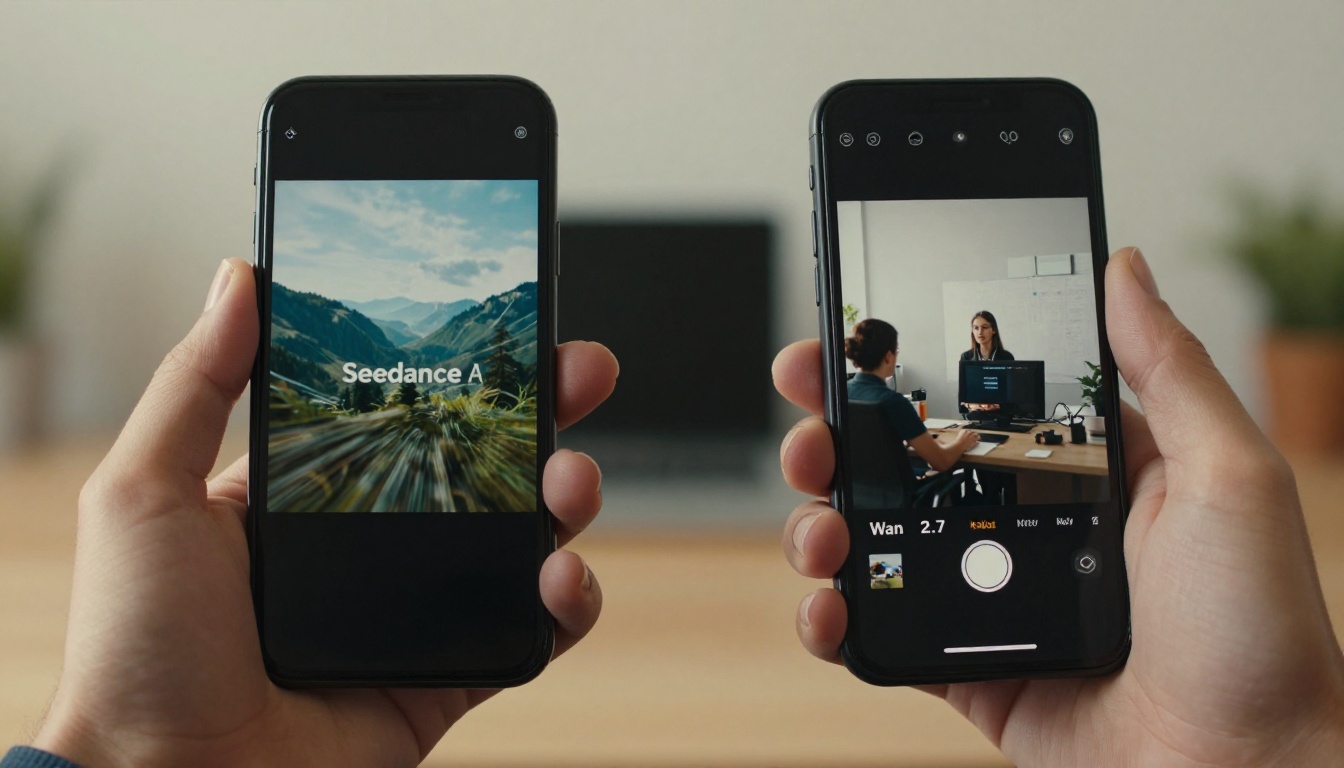
Two of the most talked-about AI video models right now are going head-to-head: Seedance 2.0 from ByteDance and Wan 2.7 from the open-source Wan Video team. Both produce 1080p output. Both handle complex prompts. Both have active creator communities generating content that ranges from polished commercial clips to boundary-pushing artistic work. The difference between them is not in raw technical capability alone. It is in philosophy, content policy, and the specific situations where each model pulls ahead.
This comparison cuts straight to every metric that matters: prompt adherence, motion coherence, generation speed, resolution ceiling, and the one question most creators are actually asking right now, which model gives you real creative freedom when the topic gets mature.
Two Models, Two Philosophies
Seedance 2.0 is a closed commercial model. ByteDance built it for production workflows: native audio synthesis, multi-shot generation, high temporal consistency. The tradeoff is a content policy that enforces hard stops on anything approaching adult or explicit material. For most professional creative work, this is not a problem. For creators pushing creative limits, it is the entire problem.
Wan 2.7 T2V is an open-weight model from the Wan Video team. The weights are publicly available, which means platforms running it have control over content filtering, not a centralized corporate server. When you use Wan 2.7 through a platform configured for creative freedom, you are working without the same hard stops.
That philosophical difference shapes everything downstream: what you can prompt, what you will receive, and what the model refuses.
💡 One-line version: Seedance 2.0 is a polished commercial product. Wan 2.7 is a powerful open model where the creative ceiling depends on the deployment, not a corporate content team.
Both models produce genuinely good video. This is not a comparison between a professional tool and a toy. It is a comparison between two serious options with different strengths for different types of work.
Seedance 2 in Detail
Seedance 2.0 arrived as one of the most capable commercial video generation models available. It handles text-to-video and image-to-video inputs. The output shows strong temporal coherence, meaning objects and characters remain stable across frames without the flickering or drifting artifacts that still appear in less mature models.
The Seedance family has expanded significantly. Seedance 2.0 Fast delivers faster generation at a slight quality trade-off. Seedance 2.0 Mini handles shorter clips with high throughput. Seedance 2.5 pushes the quality ceiling further and supports up to 30-second clips. Earlier versions like Seedance 1.5 Pro are still available for workflows optimized around them.
Built-In Audio Changes Everything
Native audio is Seedance 2.0's headline feature. The model generates synchronized audio alongside video output, which eliminates an entire post-production step that most other models still require. Ambient sounds, environmental audio, and foley-style effects are generated automatically and are reasonably well-synced to the visual content.
The audio quality is not broadcast-perfect. Synthesized dialogue and complex soundscapes still need work. But for social media, product videos, and content where background audio matters more than pristine fidelity, native audio is a meaningful advantage. No other major video model in this generation offers this at the same level of reliability.
What Seedance 2 Handles Well
Seedance 2.0's strengths fall into clear categories:
- Character consistency: Subjects maintain their appearance and proportions across multi-shot sequences better than most comparable models
- Camera motion: Slow pans, dolly shots, and tilts feel physically grounded with natural motion blur
- Lighting coherence: Shadow directions and highlight positions remain stable across frames
- Prompt specificity: When you write detailed prompts specifying scene composition, subject behavior, and environmental details, the model follows them closely
- Production speed: The commercial infrastructure means fast generation times, particularly with Seedance 2.0 Fast
Where it hits a wall: the content policy blocks anything near adult territory without warning or explanation. Attempts to rephrase mature prompts to pass the filter produce inconsistent results. You cannot reliably predict which prompt phrasing will work.
Wan 2.7 in Detail
Wan 2.7 is a major step forward from earlier Wan releases. The model family covers three distinct input workflows, each suited to different creative starting points.
Open-Source Means No Hard Ceiling
Because the model weights are open, deployment platforms decide how and whether to apply content filtering. When you use Wan 2.7 T2V on a platform configured for creative work, you are not running into ByteDance's content server. You are working with the model's actual capabilities.
In practice, this means tasteful and suggestive content, artistic themes, mature scenarios, and beauty-focused work with far fewer refusals. The model does not have a hardcoded corporate rejection system. What you can generate depends on platform configuration, not on a centralized content policy written by a legal team.
For creators working on adult-adjacent content, this is not a minor distinction. It is the difference between a tool that cooperates and a tool that apologizes.
Wan 2.7's output quality has improved substantially over previous Wan versions. The model produces 1080p video with good motion coherence, handles complex scene descriptions, and shows strong prompt adherence across a broad range of subjects and environments.
Three Ways to Generate
The Wan 2.7 family gives you three distinct input modes:
- Wan 2.7 T2V: Text-to-video. Write a prompt and generate from scratch. Best for original concepts where you are building the scene from description alone.
- Wan 2.7 I2V: Image-to-video. Animate an existing image. Perfect when you have a specific visual starting point, such as a photo or a generated image from another model.
- Wan 2.7 R2V: Reference-to-video. Animate a specific subject using a reference image, which is particularly strong for character-consistent animation across multiple scenes.
This three-mode structure gives Wan 2.7 more workflow flexibility than Seedance 2.0, which handles text and image inputs but not reference-based character animation in the same structured way.

The Real Head-to-Head
Run both models through the same range of prompts and clear patterns emerge quickly.
Prompt Adherence
Seedance 2.0 wins on complex, multi-element prompts. When your prompt specifies camera angle, subject behavior, background detail, and lighting simultaneously, Seedance 2.0 tends to follow all of them more precisely. The model shows clear benefits from training on detailed prompt-output pairs.
Wan 2.7 handles simple and moderate complexity prompts with excellent results. It starts to prioritize the most prominent subject and action in very complex prompts, sometimes at the cost of background details you specified. For most creative work, this gap is small. For highly specific commercial outputs, Seedance 2.0 has a measurable edge.
Motion Coherence
This is closer than you would expect. Both models produce stable motion without the jarring artifacts common in earlier video AI. Objects do not melt. Backgrounds do not pulse or flicker.
Seedance 2.0 handles camera motion more naturally. Dolly shots and slow pans feel physically grounded with appropriate motion blur and perspective shift. Wan 2.7 sometimes produces motion that is technically smooth but slightly mechanical during longer camera movements.
For static camera shots with character motion, the gap nearly disappears. Both models are production-usable in this category.
Speed and Throughput
Seedance 2.0 is faster across the board. ByteDance's commercial infrastructure is optimized for throughput at scale. Wan 2.7 is not slow, but if you are running many generations in sequence for iteration, the speed advantage of Seedance compounds significantly over time.
Resolution Ceiling
Both models hit 1080p. Neither is capped at lower resolutions. At 1080p, Seedance 2.0 tends to produce slightly sharper fine detail, particularly on textures like fabric, hair, and skin surface. Wan 2.7's output is marginally softer in direct pixel-level comparison but is not meaningfully different in real-world use for web and social media distribution.
For output destined for broadcast or large-screen viewing, Seedance 2.0's sharpness advantage becomes more relevant. For most distribution contexts, both are sufficient.
Uncensored Output: The Honest Take

The "uncensored" question in this comparison is not really about explicit content for its own sake. It is about whether the model will cooperate with mature creative work that exists across a broad range of legitimate contexts: adult entertainment, artistic nudity, fashion photography translated to video, glamour content, and creative work that touches on sexuality without being clinically explicit.
Seedance 2.0 runs on ByteDance infrastructure with commercial content moderation. Anything approaching adult territory gets flagged. This includes content many creators would consider tasteful or artistically defensible: implied nudity, romantic contact, suggestive swimwear shots, and mature themes in dramatic scenes. The refusals are also inconsistent, which creates an unreliable workflow. You cannot predict which prompt phrasing will pass.
Wan 2.7 is a different situation. As an open model, content policy is set at the deployment level. On platforms configured for creative content, Wan 2.7 will generate what you prompt within the model's capabilities. Tasteful and suggestive content, glamour-focused scenes, artistic body work, and mature creative themes are all within reach without the stop-and-refuse loop that Seedance 2.0 creates.
💡 For creators working on adult-adjacent content: Wan 2.7 on a platform configured for mature content is the only realistic option of the two for consistent results. Seedance 2.0's content filter makes it unreliable for anything in this territory.
For commercial-safe content where audio sync matters, Seedance 2.0 remains the stronger choice. These two models are not competing for the same use case. They serve different creative contexts, and using both strategically is the real answer.
How to Use Both on PicassoIA
PicassoIA gives you direct access to both model families without managing infrastructure. Both Seedance 2.0 and the full Wan 2.7 family are available on the platform, and you can switch between them per generation.

Running Seedance 2.0
- Open Seedance 2.0 on PicassoIA
- Write a detailed prompt: camera movement first, then subject and action, then environment and lighting
- For faster iteration, switch to Seedance 2.0 Fast
- For bulk short clips, use Seedance 2.0 Mini
- Download the result with native audio included
Prompt tips for Seedance 2.0:
- Specify lighting type explicitly: "warm golden hour backlight from the left, soft fill on the right"
- Describe what is static as well as what moves, which helps temporal coherence
- Include lens specifics when shot type matters: "35mm wide angle, slight barrel distortion"
- For longer, higher-quality output, use Seedance 2.5
Running Wan 2.7
- Choose your entry point:
- Write prompts that lead with the most important subject and action, then add environment
- For character-focused work, describe physical features in the first sentence
- Generate, evaluate, and iterate on prompts
Prompt tips for Wan 2.7:
- Front-load subject and primary action for better results
- For Wan 2.7 I2V, generate your starting frame first using a text-to-image model, then animate it: this gives you precise control over the initial frame
- If Wan 2.7 is busy, Wan 2.6 I2V and Wan 2.5 T2V are solid alternatives
Pick Your Fighter
| Criteria | Seedance 2.0 | Wan 2.7 |
|---|
| Audio output | Built-in native | None |
| Content freedom | Restricted | High |
| Prompt adherence | Excellent | Good |
| Camera motion | Natural | Good |
| Speed | Fast | Moderate |
| Resolution | 1080p | 1080p |
| Input modes | Text, Image | Text, Image, Reference |
| Open weights | No | Yes |
Choose Seedance 2.0 when:
- Native audio in the output is important
- Your content stays within commercial content guidelines
- Speed matters for iterative workflows
- You want production-polished output without additional post-production
Choose Wan 2.7 when:
- Your content requires creative freedom that Seedance 2.0 blocks
- You want to animate existing images precisely with Wan 2.7 I2V
- You need character-specific animation via Wan 2.7 R2V
- Open model weights matter to your workflow or research
Many serious creators run both. Seedance 2.0 for deliverables that need audio and stay within content guidelines. Wan 2.7 for content requiring fewer restrictions. Having both on a single platform removes the friction of managing separate tools and accounts.
Create Your Own Now

Reading a comparison only takes you so far. The real answer to which model fits your workflow comes from generating with both. Start with the same prompt on Seedance 2.0 and then on Wan 2.7 T2V. The differences in motion style, prompt interpretation, and visual character become immediately clear when you have two clips side by side.
If you have a specific subject to animate, take it into Wan 2.7 I2V. For a commercial clip with audio for a product or brand, use Seedance 2.0. For longer-form work where generation length matters, see what Seedance 2.5 does with it.
Beyond these two model families, PicassoIA hosts over 87 text-to-video models, including Kling v3 Video, Veo 3, Ray 3.2, and Hailuo 02. The platform also offers video effects tools, quality upscaling, and post-generation refinement options for taking any output further.
Head to picassoia.com/en/all-models to see the full library and start generating with both models today.


