Two AI image generation models are dominating the conversation in 2027. Seedream 4, ByteDance's flagship diffusion model, and Flux Kontext, Black Forest Labs' context-aware powerhouse, have drawn serious attention from professionals, hobbyists, and researchers alike. Both produce stunning results, but they take fundamentally different approaches to how images get made, what they prioritize, and where they fall short. If you have been confused about which to use, or even which produces better results for specific tasks, this breakdown cuts through the noise.
What Seedream 4 Actually Is

Seedream 4 is ByteDance's fourth-generation text-to-image model, built on a hybrid architecture that combines diffusion and flow-matching techniques. Unlike many models that focus purely on aesthetic output, Seedream 4 prioritizes prompt coherence, making it exceptionally precise at following complex, multi-layered instructions.
The model was trained on an enormous multilingual corpus, which gives it a distinct advantage for non-English prompts and culturally diverse visual content. Its understanding of spatial relationships is notably strong, producing images where objects occupy the positions described in the prompt with unusual accuracy.
Seedream 4 Key Strengths
- Prompt fidelity: Multi-subject, complex scene descriptions execute accurately
- Multilingual support: Native processing of Chinese, Japanese, Korean, and other non-Latin scripts
- Spatial reasoning: Objects and characters placed correctly relative to each other
- Text rendering: Significantly better at generating legible text within images than earlier models
- Resolution control: Supports native high-resolution outputs without tiling artifacts
- Speed: Faster average generation time at standard quality settings
Where Seedream 4 Falls Short
Seedream 4's photorealistic output, while strong, can feel over-processed in certain scenarios. Skin tones occasionally trend toward idealized rather than natural. Portrait subjects sometimes carry a subtle "polished" quality that trained eyes recognize immediately. It also requires more deliberate prompting for abstract or conceptual scenes, where Flux Kontext tends to show more creative inference and interpretive flexibility.
What Flux Kontext Actually Is

Flux Kontext is Black Forest Labs' context-aware image generation and editing model, representing a significant evolution over the original Flux Dev and Flux Schnell releases. The defining feature of Kontext is not raw generation quality alone. It is the model's ability to maintain context across edits, transformations, and iterative changes.
Where most models treat each generation as a blank slate, Flux Kontext treats it as a conversation. You can modify an image, keep the character consistent, change the background, alter lighting, or shift the style, and the model maintains subject identity across those changes. This is the capability that professionals have been waiting for.
Flux Kontext Key Strengths
- Context preservation: Subject identity maintained across edits and transformations
- Instruction-following for edits: Natural language editing that actually delivers consistent results
- Style coherence: Consistent aesthetic across variations of a scene
- Inpainting quality: Fills and corrections that blend seamlessly with surroundings
- Character consistency: Reliable face and body consistency across multiple generations
- Creative inference: Strong performance on abstract and conceptual prompts
Where Flux Kontext Shows Limits
Flux Kontext can occasionally over-smooth fine details when performing heavy edits, particularly around hair and intricate fabric texture. Its base generation quality without any context from a reference image is excellent but not quite as prompt-precise as Seedream 4 for complex multi-subject scenes. The model also benefits significantly from high-quality reference inputs, meaning the quality ceiling is partially determined by what you feed it.
Head-to-Head: Generation Quality

This is where things get nuanced. Both models produce outputs that can genuinely fool careful observers. The differences only emerge when you look at specific scenarios and task types.
| Task | Seedream 4 | Flux Kontext |
|---|
| Complex multi-subject scenes | Excellent | Very Good |
| Portrait photorealism | Very Good | Excellent |
| Text in images | Excellent | Good |
| Creative and abstract concepts | Good | Very Good |
| Consistent character edits | Limited | Excellent |
| Style transfer | Good | Excellent |
| Non-English prompts | Excellent | Good |
| Inpainting and corrections | Good | Excellent |
| Speed at standard quality | Fast | Moderate |
| High-resolution native output | Very Good | Very Good |
| Batch generation reliability | Very Good | Good |
Worth noting: Neither model has a universal edge. The winning choice depends entirely on your workflow and the specific task in front of you.
Prompt Engineering: What Works for Each

Getting the best from both models requires understanding how they interpret prompts differently. The structural approach that produces excellent results in one model often produces mediocre output in the other.
Seedream 4 responds well to:
- Explicit scene descriptions with subject, environment, lighting, and camera specifications listed out
- Deliberate attribute listing ("tall woman, short dark hair, yellow jacket, standing near a window")
- Quality tags: "photorealistic, 8k, cinematic, RAW photo, natural lighting"
- Specific cultural and stylistic context phrases that anchor the visual output
- Sequential scene construction (foreground, midground, background described in order)
Flux Kontext responds well to:
- Natural language editing instructions ("change the background to a forest", "make the lighting warmer")
- Reference image plus modification approach
- Creative directional phrases: "painterly quality", "soft editorial focus", "fashion magazine style"
- Iterative refinement via follow-up instructions that build on the previous output
- Character-first descriptions that anchor identity before describing scene elements
The practical implication is significant. If you are building a generation workflow from scratch with no reference material, Seedream 4's prompt architecture gives more predictable results. If you are iterating on existing images or maintaining character consistency across a set, Flux Kontext is the clear choice by a wide margin.
Real-World Use Cases

When to Pick Seedream 4
Seedream 4 is the right tool when:
- You are generating product photography or commercial imagery from text alone
- Your prompts are written in languages other than English
- You need precise object placement and spatial accuracy in complex scenes
- The brief includes visible text in the image, such as signs, labels, or UI elements
- Speed matters and you are running large batch generation workflows
- The creative brief is specific enough that iteration should not be necessary
When to Pick Flux Kontext
Flux Kontext wins when:
- You are editing existing images with specific natural language instructions
- Character or subject consistency across multiple images is critical to the project
- You need to iterate rapidly with corrections that preserve the rest of the image
- Your workflow involves inpainting, outpainting, or targeted object replacement
- You are working on campaigns where stylistic coherence across dozens of outputs is non-negotiable
- The creative process involves feedback loops where humans review and redirect the output
Architecture Differences That Actually Matter

Both models use diffusion-based architectures but with important structural differences that directly explain the output characteristics you see in practice.
Seedream 4 uses a hybrid approach combining denoising diffusion with flow-matching elements. This gives it strong global coherence, meaning the whole image "makes sense" together even in complex multi-subject scenes. The trade-off is slightly less flexibility for targeted local edits, since the global coherence mechanism resists partial changes.
Flux Kontext is built on the Flux.1 rectified flow transformer architecture, extended with a context attention mechanism that references prior states during generation. This is what enables its editing coherence. The context attention adds computational overhead, contributing to its slightly slower generation speed compared to Seedream 4 at equivalent quality settings.
Architecture note: Flux Kontext's context attention runs during the denoising process itself, not as a post-processing step. This integration is why edits feel genuinely incorporated rather than composited on top.
Training data differences also shape the output. Seedream 4's multilingual training corpus makes it one of the few frontier models that genuinely understands cultural visual references from non-Western contexts, whereas Flux Kontext's training leans more heavily toward Western editorial and commercial photography aesthetics.
Parameter count matters too. Both are large-scale models, but their efficiency profiles differ. Seedream 4 trades parameter efficiency for speed. Flux Kontext accepts slower inference in exchange for its context-handling capabilities.
Working with These Models on PicassoIA

PicassoIA gives you direct access to the most powerful text-to-image models available from the Flux family, including Flux Dev, Flux Schnell, and Flux Pro. These models are available immediately with no setup or API key management required, running on professional-grade GPU infrastructure.
If you have been experimenting with Flux models elsewhere, the PicassoIA implementation adds:
- Access to Flux Pro for premium-quality outputs at the highest fidelity tier
- Stable Diffusion XL as a high-speed alternative for bulk generation workflows
- Super Resolution tools to upscale and sharpen AI-generated images by 2x to 4x
- Face Swap capabilities for consistent identity across generated content sets
- Background Removal for clean product photography extractions
- Inpainting and Object Replacement for non-destructive image editing
The platform handles the infrastructure. You handle the creative direction. That division means a small team can produce professional-volume output without managing cloud compute or dealing with rate limits.
Image Quality: Where Texture Tells the Truth
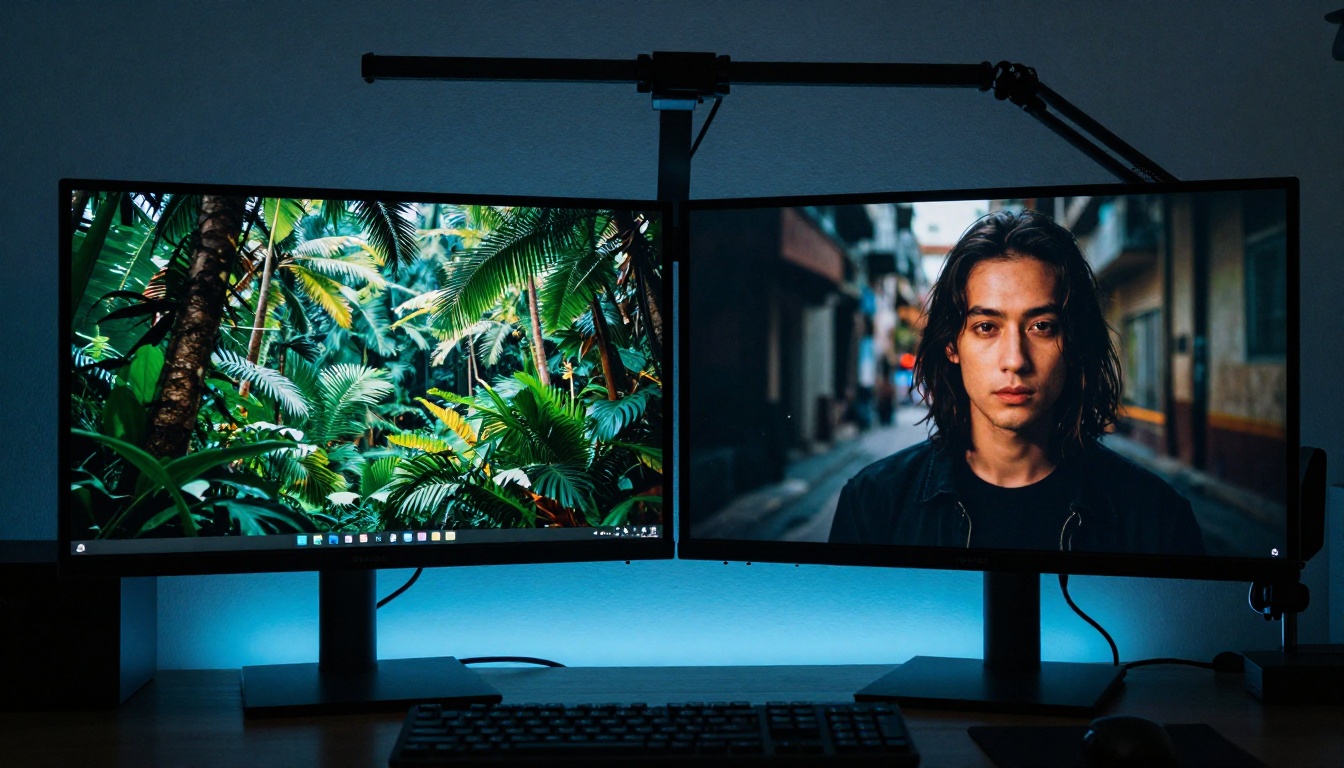
One of the most telling differences between the two models shows up in micro-detail rendering. These are the elements that determine whether an image reads as genuinely photographic or subtly artificial to a trained eye.
Skin texture: Seedream 4 renders skin with strong macro-level realism but can smooth pores and micro-texture in close-up scenarios. Flux Kontext's portrait rendering tends toward more natural skin variation, particularly beneficial in editorial photography contexts where over-retouching reads as artificial.
Fabric and material: Both models handle common materials well. Seedream 4 has a slight edge in rendering complex patterned textiles and structured garments. Flux Kontext performs better with layered fabrics in motion and loose, organic draping.
Hair: Flux Kontext consistently produces more convincing individual hair strand separation and natural flyaway behavior. Seedream 4 renders hair mass and general shape well but can lose individual strand definition in high-detail close-ups.
Lighting interaction: Both models understand directional lighting, but Flux Kontext's attention to sub-surface scattering, the way light passes through skin, tends to produce more convincing portrait lighting in complex setups with multiple light sources.
Architecture and hard surfaces: Seedream 4 has a clear advantage here. Straight lines stay straight, perspective is accurate, and structural details like brick texture, concrete grain, and metal surface finishes render with high fidelity and geometric precision.
Practical tip: For architectural and product shots where geometry matters, start with Seedream 4. For portraits and lifestyle content where natural human texture matters, start with Flux Kontext.
The Output You Can Actually Use

Both models produce images at resolutions suitable for professional use. The question is not whether the images are high enough quality. It is whether they are the right type of quality for your specific application and downstream use.
Commercial photography: Seedream 4's precise prompt following makes it more reliable for briefs with specific requirements. When the art director says "three products on a marble surface with soft north-facing window light," Seedream 4 delivers that brief accurately without extensive iteration.
Editorial and creative content: Flux Kontext's iterative refinement capability makes it the natural choice for editorial work, where the image often evolves through multiple rounds of feedback. Natural language editing instructions reduce friction between creative intent and final output.
Social media content at scale: Speed and volume favor Seedream 4. For high-throughput content generation where dozens or hundreds of images need to be produced to a consistent brief, its combination of prompt accuracy and generation speed is difficult to match.
Video thumbnails and cover art: Either model works, but Flux Kontext's ability to maintain character consistency across a set of thumbnails gives it a practical advantage for channel branding and serialized content where the same subject appears repeatedly.
Product and e-commerce: Seedream 4 is the stronger choice for product imagery where clean backgrounds, accurate color rendering, and geometric precision matter more than naturalistic human texture.
Which Model Is Winning in Practice
Based on real-world professional workflows, a clear pattern has emerged. Teams that prioritize iterative creative workflows with human feedback loops have adopted Flux Kontext as their primary editing tool. Teams that need reliable batch generation from detailed text briefs tend to keep Seedream 4 as their production workhorse.
The versus framing is useful for comparison but somewhat misleading about how practitioners actually work. Most serious professionals use both models, assigning each to the tasks it handles best rather than picking one as a universal solution.
Where Flux Kontext genuinely wins: anywhere that human feedback needs to be incorporated into the generation loop, anywhere that saying "can you make the background slightly warmer and remove that shadow near her chin" needs to produce a result that looks like a refined version of the same image, not a completely new generation.
Where Seedream 4 genuinely wins: anywhere that a detailed text brief needs to produce a specific, accurate visual output on the first or second attempt, particularly for non-English language workflows and architectural or product-heavy content.
The models are not in competition. They are tools with different strengths, and the practitioners getting the best results are the ones who stopped treating the choice as binary.
Try It on PicassoIA
The fastest way to understand the real difference between these frontier models is to run your own prompts through them and see the outputs side by side. PicassoIA gives you immediate access to the most capable models available, including the full Flux Dev and Flux Pro lineup, alongside Super Resolution, Face Swap, Background Removal, and full image editing capabilities that let you take raw generations to professional-quality outputs in minutes.
Start with a prompt you have been struggling to get right elsewhere. See what these frontier models actually produce. The quality difference between frontier-class models and the previous generation is large enough that most people stop questioning which model to use and start questioning why they waited so long to switch. The tools are there. The infrastructure is ready. Start generating.


