The numbers are hard to ignore. AI companion apps have quietly crossed into mainstream territory, with some platforms logging millions of active users per month. But the category growing fastest is one many tech publications still sidestep: uncensored AI girlfriend apps. These aren't just chat interfaces with a personality. They're layered experiences that combine large language models, voice synthesis, and AI-generated visual content, and the demand for them isn't slowing down.
This isn't a niche movement. It's a clear market signal pointing at something real: people want digital companionship that doesn't sanitize everything they say, think, or want to create.
What's Actually Fueling the Surge
The growth of uncensored AI girlfriend platforms didn't happen in a vacuum. A few converging forces made this moment almost inevitable.
The Privacy Factor No One Talks About
People talk to AI companions about things they wouldn't tell their therapist, their partner, or their closest friends. That's not a bug in the system. It's the feature that makes these apps genuinely useful for millions of users. The appeal isn't always about romance or fantasy. Often it's about having a space that doesn't judge, doesn't remember in ways that feel threatening, and doesn't push back with moral corrections every third sentence.
Censored AI platforms build friction into every sensitive topic. That friction might feel responsible from a platform perspective, but it signals to users that they're not trusted. Uncensored alternatives send a different message: this is your space.
The Gap Between Chat and Creation
Early AI girlfriend apps were text-only. You typed, the AI responded. That still drives a huge share of usage, but the category has evolved rapidly. Users now expect visual output alongside conversation. They want to see what their AI companion looks like, in specific outfits, settings, and moods. They want voice responses that sound natural, not robotic. The apps growing fastest aren't just better chatbots. They're full creative toolkits.
This is where AI image generation has become central to the entire category.

What Users Actually Want in These Apps
Before we get into the tools, it's worth being specific about what people are actually looking for. The demand isn't random. It clusters around a few consistent features.
No Content Filters on Generation
The single biggest differentiator between mainstream AI tools and the apps gaining traction in this space is filter behavior. Mainstream platforms block a wide range of prompts, often including content that's suggestive but not explicit. Users who've been rejected by a dozen safe-for-work generators for prompts that contain the word "bikini" don't forget that experience. They go looking for something that treats them like adults.
The apps winning in this space let users prompt freely. That's the baseline expectation now.
Customization at Every Level
Generic companions don't hold attention. The apps people return to most often let users define:
- Physical appearance: body type, hair color, facial features
- Personality traits: confident, shy, playful, intellectual
- Voice and speech patterns
- Backstory and relationship dynamic
- Visual style in generated images
The more levers users can pull, the more the experience feels personal. That personalization is what keeps people coming back.
| Feature | Basic Apps | Uncensored Apps |
|---|
| Content filters | Strict | Off or adjustable |
| Image generation | Limited or none | Full NSFW support |
| Voice synthesis | Basic TTS | Natural speech models |
| Personality setup | Template-based | Deep customization |
| Image editing | None | Img2img support |
Speed and Quality Together
Early NSFW generators produced images that looked uncanny. Flat lighting, strange proportions, that telltale AI sheen that made everything look plastic. That era is over. The best models available today produce images that are genuinely difficult to distinguish from professional photography. And they're fast. Users aren't willing to wait 30 seconds for a single image. The platforms winning right now deliver results in under 3 seconds.

Best Models for AI Companion Visuals
If you're using an app that relies on AI image generation for visual companion content, the model underneath matters enormously. Here's what's actually available for creators who want uncensored, high-quality output.
Start With Seedream 4.5
Seedream 4.5 is the top recommendation for NSFW AI image generation right now. It generates ultra-realistic content, supports image editing alongside text-to-image, and delivers results in under 3 seconds. If you've been using models that block your prompts or produce uncanny output, Seedream 4.5 is a significant step up. The realism reaches a level where skin texture, lighting, and fabric detail all render naturally without the plastic sheen that marks lower-quality generators.
One important note: the newer Seedream 5 Lite does not support NSFW content. Stick with 4.5 for unrestricted generation.
💡 Tip: Seedream 4.5 accepts both text prompts and image inputs for editing. You can generate a base image and then refine specific details without starting from scratch.
Unlimited Generations with Image Editor Pro
PicassoIA Image Editor Pro has a different value proposition: volume. With an Elite or Infinite plan, generations are unlimited. If you're building a large library of companion visuals, that math changes completely compared to credit-based models where 1,000 images could cost around $100. Here, those same 1,000 images are included in your plan. The model also returns results in under 1 second, accepts NSFW prompts, and offers a 3-generation free trial without requiring a credit card.

The Full Lineup Worth Knowing
PicassoIA offers several models built for unrestricted, realistic content creation:
- Seedream 4.5 ⭐ - The best all-around NSFW model. Accepts adult content, supports image editing, and generates ultra-realistic results in under 3 seconds.
- PicassoIA Image Editor Pro - Img2img with unlimited generations. Need 1,000 images? They're free with your Elite or Infinite plan. Accepts NSFW, returns results in under a second, and includes a 3-generation free trial with no credit card required.
- Qwen Image 2 - Open-source model that edits or creates any image in seconds with very detailed realism.
- Grok Imagine Image - Realistically converts any image to a bikini format.
- Recraft V4 - Very realistic results for text-to-image generation.
- P-Image - NSFW text-to-image generation in under 1 second.
Unlike many mainstream AI platforms, PicassoIA gives creators full creative freedom with uncensored, high-performance models.
How to Use Seedream 4.5 on PicassoIA
If you've never used an uncensored text-to-image model before, here's exactly how to get results from Seedream 4.5 on your first try.
Step-by-Step for Your First Generation
Step 1: Open the model
Go to picassoia.com/en/collection/text-to-image/bytedance-seedream-45 and log in to your PicassoIA account. You don't need a paid plan to start generating.
Step 2: Write a detailed prompt
The more specific you are, the better the result. Instead of "attractive woman on beach," write something like:
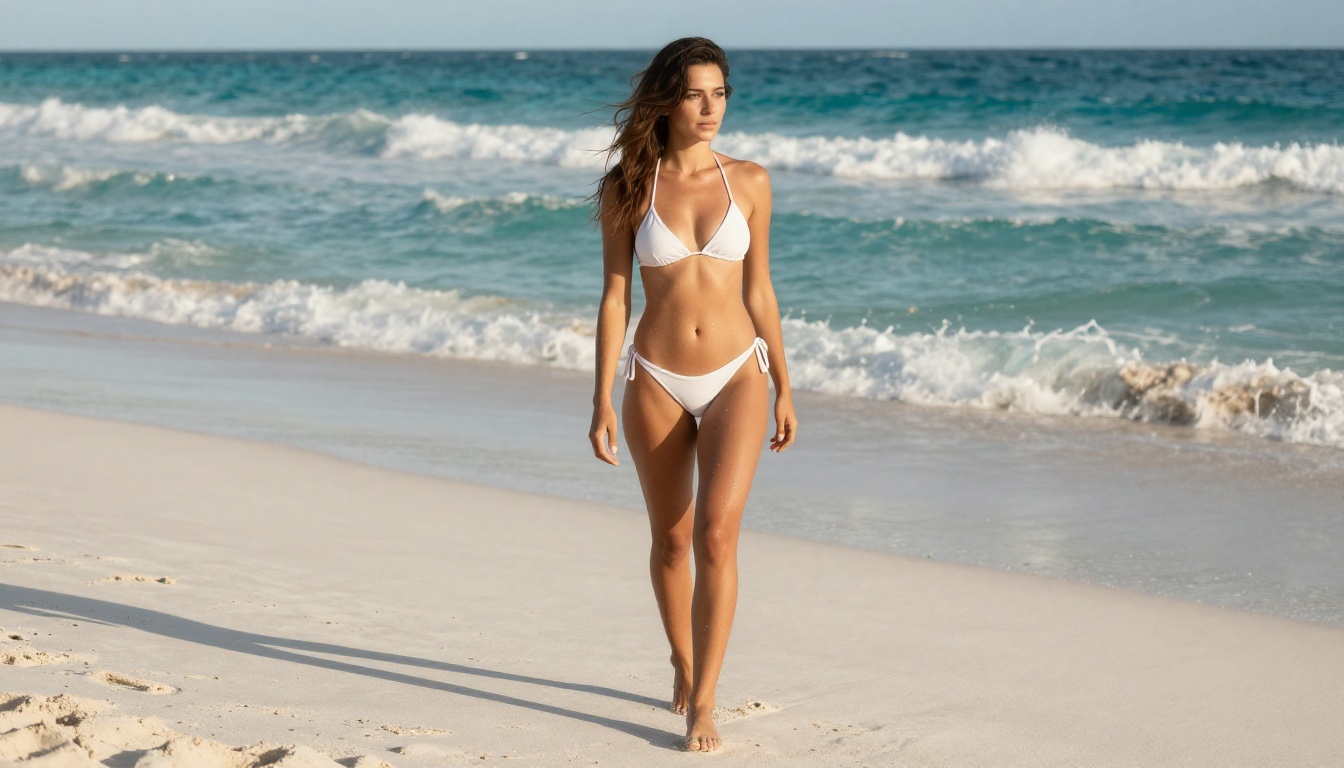
"A woman in a white string bikini standing at the water's edge on a white sand beach, warm afternoon side light from the right, turquoise ocean, 85mm f/1.8 lens, photorealistic, Kodak Portra 400 grain"
Step 3: Set your aspect ratio
For companion-style imagery, 16:9 works well for landscape scenes. For portrait-style shots, 9:16 gives better proportions.
Step 4: Generate and refine
The model generates in under 3 seconds. If you want to adjust specific details, use the image editing mode: upload your result and describe what you want changed. Seedream 4.5 handles both the initial generation and the editing workflow in one place.
Step 5: Scale up with Image Editor Pro
Once you have a base image you like, switch to PicassoIA Image Editor Pro to create variations at unlimited volume. Same base image, different outfits, different settings, different lighting.
💡 Tip: The more specific your lighting description, the more photorealistic your result. "Warm afternoon golden light from left, visible rim light on shoulder" produces far better output than just "good lighting."
Voice and Language in AI Companions
Visual content is only one part of what makes AI companion apps compelling. The two other pillars are voice and language, and both have reached a quality level in 2027 that would have seemed implausible two years ago.
Large Language Models Running the Conversation
The conversational backbone of most AI girlfriend apps today is a large language model. These models handle everything from roleplay to casual conversation to emotional support. On PicassoIA, the large language models section gives creators access to LLMs that can be prompted for companion-style interactions without the heavy content filtering that characterizes mainstream consumer chatbots.
The difference in experience between a filtered LLM and an uncensored one is significant for this use case. Filtered models break immersion constantly. They interrupt roleplays to add disclaimers. They refuse to respond to scenarios that aren't remotely harmful but sit outside their training guidelines. Uncensored alternatives treat the user as the author of their own experience.
Text-to-Speech That Actually Sounds Human
Text-to-speech has historically been the weak link in AI companion apps. Robotic delivery kills immersion faster than anything else. That's changed significantly with modern synthesis models. On PicassoIA, text-to-speech capabilities let creators generate voice output that carries natural prosody, pacing, and emotional inflection.
For companion app builders, this means users can now receive spoken responses that feel warm and present rather than mechanical. The combination of a natural voice model with a capable LLM is what separates the best apps in this space from everything else.

Why This Moment Matters for Creators
It's easy to focus on the end-user angle here, but there's a significant creator opportunity in this space that often goes unmentioned. AI companion content is a growing content category. Creators who build high-quality visual libraries, develop unique AI companion personas, and distribute through the right channels are finding real audiences.
The tools available now remove almost every barrier that existed two or three years ago. You don't need to hire photographers. You don't need specialized software knowledge. You need access to a capable image generator, a solid prompt strategy, and a platform that doesn't restrict your creative choices.
The Cost Argument is Settled
A professional photography session to produce 50 companion-style images might cost several thousand dollars. The same volume on PicassoIA, using Seedream 4.5 or PicassoIA Image Editor Pro, costs a fraction of that. With unlimited generations included in Elite and Infinite plans, you can produce 1,000 images for what a single traditional photography session might cost.
No Gatekeepers on Style or Content
Traditional content production runs through layers of approval: art directors, platform policies, brand guidelines. AI generation on an uncensored platform runs through exactly one filter: your own creative judgment. That's a significant operational advantage for creators who want to move fast, iterate freely, and produce in volume.

It's worth being clear about what's actually out there. Several categories of platform have emerged in this space:
Roleplay-focused platforms prioritize the conversational experience. They use LLMs to generate responses in a specific persona, and some allow users to define the persona's appearance and backstory in detail.
Visual-first platforms emphasize image generation. Users describe what they want to see, and the platform generates it. Many now include a chat component alongside the image generator.
Hybrid creator tools like PicassoIA aren't specifically marketed as AI girlfriend apps, but they power many of the visuals that appear in those apps. Creators who build companion content use image generation models, LLMs, and voice synthesis tools from platforms like this to construct their own experiences.
The users driving the most growth aren't just passive consumers. Many of them are creators building their own companion content, either for personal use or for distribution to paying audiences.

Build Your Own AI Companion Now
The apps that have caught mainstream attention are using the same tools you have access to right now. The gap between using an AI girlfriend app and building your own is smaller than it has ever been.
If you want to create original companion-style AI imagery without content restrictions, Seedream 4.5 is the place to start. If you need volume at scale, PicassoIA Image Editor Pro gives you unlimited generations on Elite and Infinite plans. For variety in your approach, Qwen Image 2, Grok Imagine Image, Recraft V4, and P-Image each offer distinct strengths worth testing.
For voice and language, PicassoIA's text-to-speech and large language model offerings round out a toolkit that covers every layer of the AI companion experience.
The apps having a moment right now aren't magic. They're built on accessible tools, smart prompting, and the willingness to create without a filter in the way.
👉 See every available model and start creating without restrictions at picassoia.com/en/all-models.


